A lot of people are jumping on the personal brand bandwagon (including me). But something that always felt a bit hollow to me was its most common approach:
Building an audience first, before having a product.
Admittedly I’ve been taken into this idea for quite a while too. I learned how to build a little Twitter following, ran a top ranked podcast, made another one that hit #9 for indie marketing podcasts, and I’ve been writing this newsletter for a while now, too.
But honest ROI across all of it: almost zip in terms of actual clients or inbound.
And the whole time it felt a bit like tapdancing for approval. The realm of performative posting, annoying platitudes, follow for follow, and other distasteful behaviour on social media.
(Jakob Greenfield point this out as part of the Bullshit Creative Industrial Complex 🤣)
I enjoy the writing, I don’t mind the work. But I don’t really like the feeling of putting yourself forward as special, or positioning yourself as a thought leader before you’ve really done much thinking worth leading on. Maybe that’s just me.
Then I came across an essay on Ryan Reynolds’s business model that described how he built a massive profile, and then pointed it like a death star at his various projects and something kind of clicked.
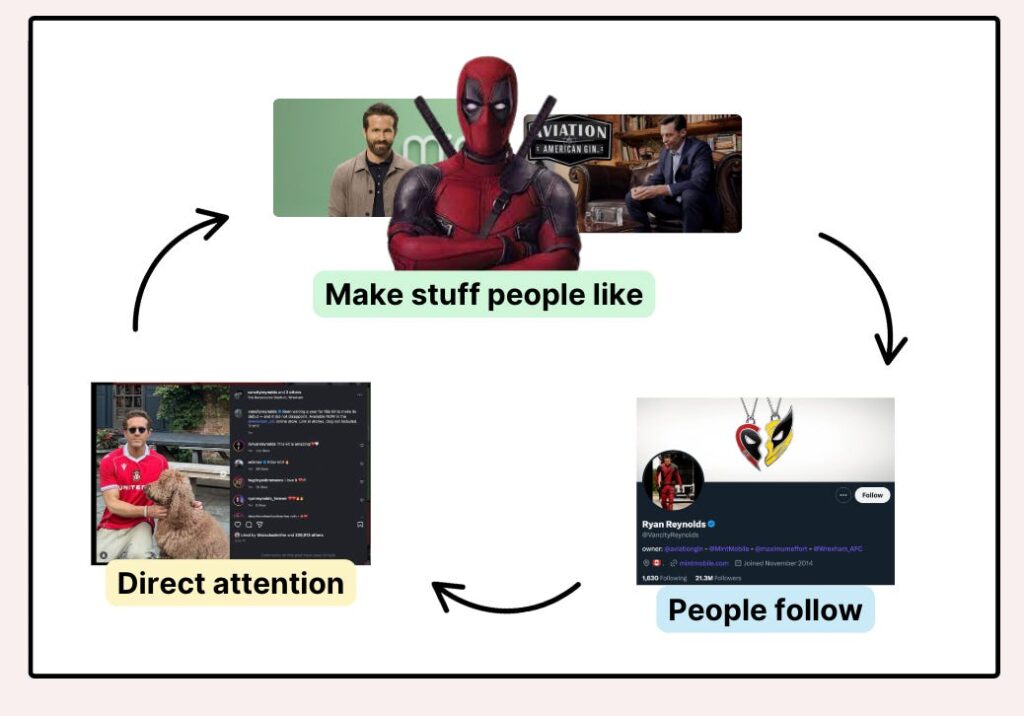
Ryan didn’t build a personal content brand, smashing out hit tweets or post-maxxing on Linkedin.
He made movies people liked, showed up in them, and got followed because of the work. Then appeared as himself in Aviation Gin, Mint Mobile, Maximum Effort. People followed him because they liked what he made, not because he was posting about his morning routine, and he directed that affinity to the other businesses he was working on.
A few things stand out from how he did it, and I think they’re worth noting:
- He kept his name out of the brand name. Had he called it Reynolds Gin, it’d be much harder to sell. Instead he just appeared in it. Severable asset, personal visibility. Both at once.
- The project came first, the following came second. People didn’t follow Ryan and then get interested in his projects. They found the projects and then got interested in him. His movies are part of the funnel.
- He actually showed up in the content. Seems obvious but think about it. Big name CEOs instantly get loads of followers when they join social platforms. You need to be seen in it.
- He used his profile for commentary, not as the main event. His social channels point to his work, they don’t replace it. The work lives elsewhere. Admittedly his stuff is a little dry but can’t deny it most likely words.
You see this with others too.
Rand Fishkin got known through Whiteboard Friday at Moz. Gary Vaynerchuk built his following through Wine Library TV. Peter Askew went semi-viral with “I Sell Onions on the Internet” after building Onions.com. None of them led with a personal brand, yet they made one because of their work.
What I’m doing instead
Now I’m doubling down on Hungry Bear, my social ads micro-agency, rather than anything follower focused. It has a YouTube channel, newsletter, client work. I’ll be sure to write and present as myself – a marketer who does the work – but keep the business brand rather than my name, so it’s severable if needed. A bit like Ryan’s model.
And I think it doesn’t necessarily make come across as corporate. Gil Gildner runs Discosloth and still comes across completely human. I think the person and the brand fit together pretty naturally. So if you’re worried, using a business name doesn’t put a wall between you and the reader, or at least it doesn’t have to.
The other thing I didn’t expect: it mostly removes the content overwhelm problem entirely.
I’m not managing personal “content buckets” or figuring out what niche to post in. I just make videos for the specific people I want to work with, and that’s pretty much the whole plan.
There’s something almost stupid-simple about it that I think is probably correct.
Now my actual goal right now isn’t to build an audience. It’s to build Hungry Bear into something good enough that the right people find it and care about it. If people read this, great. If they subscribe, even better. But I’m not really optimising for that.