I’ve been meaning to work on my short form video skills for a while now. Video usually performs better than statics, and everyone keeps saying story based formats do even better.
I got tired and envious of all these vloggers doing these little short story posts that look so effortless and natural, and I wanted to learn how to write video scripts the same way.
The problem was most of the storytelling frameworks out there I came across are either too vague (“story telling is about pain!”) or bloated. Like the hero’s journey, it’s like twelve different steps.

I don’t know who’s mashing that into a 15 or 30 second video.
So I started researching how social media storytelling works in a step-by-step way and came across Isabella Sanchez who makes content specifically for vloggers on how to tell stories. Her course turned out to be perfect because I was looking for something that would teach it step by step.
In the course she teaches a framework for storytelling based on a few key beats (my paraphrasing):
- Interesting characters
- Have goals
- With obstacles
- Resolved
Wrapped with a concept.
So an example could be something like “Ranking the the best and worst pizza shops but only by their bathrooms because I’m a broke university student.”
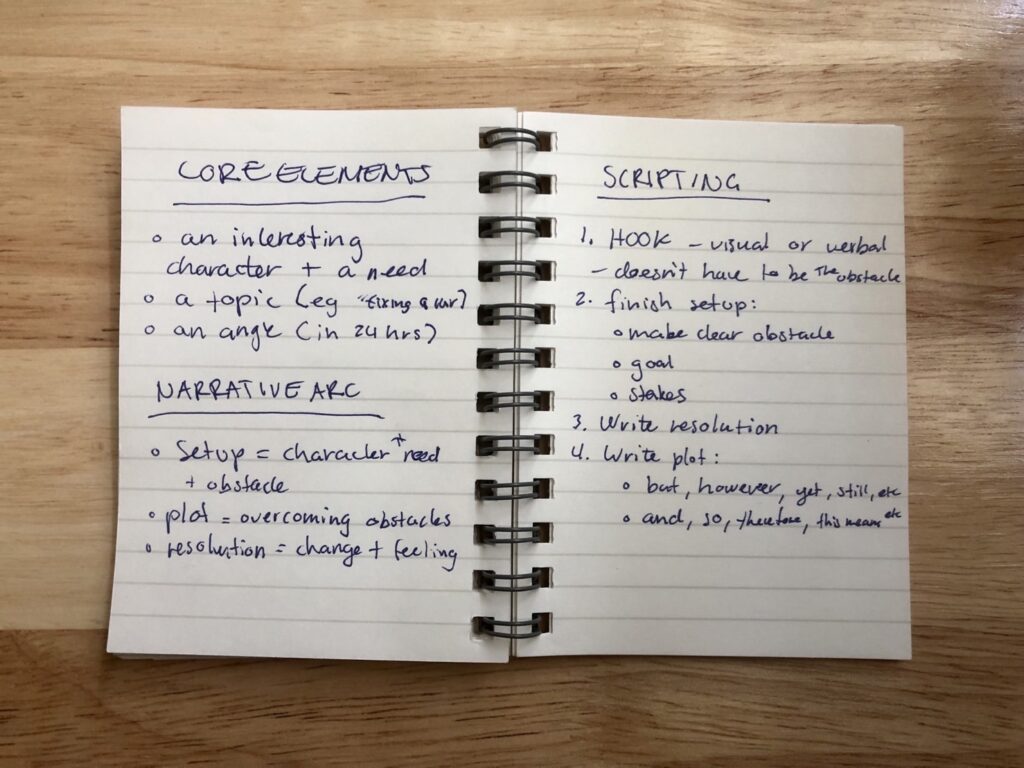
Sounds stupid but the major thing that clicked for me was that the goal and obstacle are not the same thing. Even though it’s easy to write like they are.
A lot of the times when I’ve written story-like video ads, I’ve conflated the two because it often seems like the goal IS the obstacle. Like “trying to get 1,000 YouTube subscribers.” When the obstacle is more like being lazy, not knowing where to start, etc.
Application
I’ve used this on at least two shorts so far, including about how I’d go about learning ads again (my very first attempt).
And on the blog, for these posts:
- 18 months to get 100 YouTube subscribers
- Writing on platforms instead of my blog was a 3 year mistake
The last one is interesting because it’s technically macro-fail but people seemed to liked the way it was written.
No clean data on any of this yet but to be fair, I think that’s less about the technique and more about reps. My bet is the more I do it, the better I’ll get at dialing it in, for shorts, for the blog, and hopefully eventually for the ad scripts I’m writing for clients.
What I do now when I check a draft:
- Make sure I have explicitly communicated a goal and an obstacle – making both clear.
- Check if there is a narrative but/therefore line through to the clear conclusion, not simply a sequence of events.
By the way it’s absolutely worth the $97 I paid for this. It’s one of the better short courses I’ve bought, and I’ve gone back through it two or three times now. You can get it on her website here.