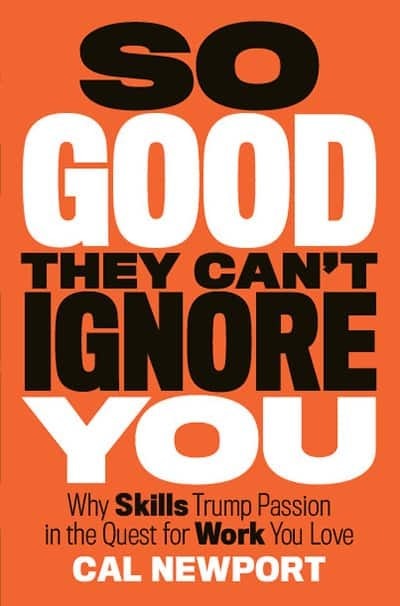
A while back I came across the concept of career capital from Cal Newport's book So Good They Can't Ignore You. The basic idea is that skills, networks, and credentials are a form of capital. Things you build up over time and trade for the lifestyle and compensation you want.
Think of the cranky technical expert who can take their pick of clients and charges eye-watering rates. That's career capital working.
I found it intuitively true. But I couldn't quite figure out how it applied to marketing specifically or to being freelance or solo.
So I asked a friend who manages a large marketing team what skills he thought were most valuable to develop. He said PPC skills are always in demand. Useful, but not quite what I was looking for. That's a job function, not really a lens for deciding what's worth building.
The clearer answer came from a different conversation. A friend of mine, fellow digital nomad, had just sold his business, was thinking through what he'd do next. He said he wanted to get back into consulting, but in a more leveraged way. Not hands-on delivery. Something where he could still earn well without running a traditionally staffed operation.
His answer: consulting built around uncommon expertise applied to a difficult objective.
That clicked for me. Career capital for marketers isn't really about job titles or broad skill categories. It's about being the person who can solve a hard, specific problem that most people can't.
So for example, not just "I run Facebook ads," but "I improve conversion rates on PPC campaigns where Facebook can't track the conversion data." Not just "I know Asana," but "I can set up and train an entire team on an efficient Asana workflow from scratch." That type of thing.
The distinction matters because the second version is rare. The first version has a hundred applicants.
Looking at my own skills, I can see the beginnings of some areas where I could build something like this. Conversion rate optimisation is one I know the basics, but I haven't really pushed into a genuinely hard version of that problem. Content distribution without an existing audience is another (and honestly, if you've cracked that one, I'd love to hear about it).
The filter I'm now using when deciding what to invest time in: does this make me better at a hard, specific objective or am I just adding another general skill to a long list?
That's the question I'd suggest asking too.
 Benjamin Boman
Responses (0)