If freelancing were a game, what would be the map? And has anyone written the guide?
I came across something like that back in 2022: Lex DeVille’s video on the three levels of Upwork. Even though it was just about Upwork, looking back, I think it gives clues to the main freelancer arc, not just that platform.
The TLDR of his video is: in the beginning, you have to be really scrappy and take whoever you can. In the middle, you try to raise your rates to something livable, not just bottom of the barrel, but you still have to hustle. Then at the end, it shifts to inbound and mostly high rates.
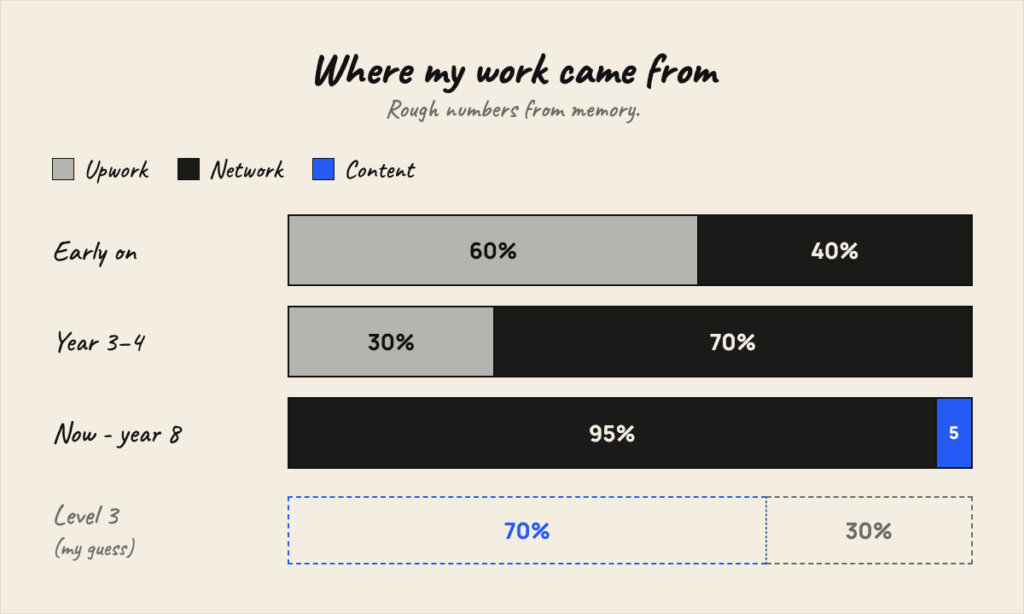
I can see that arc in my own freelance work too:
- In the beginning: roughly 60/40 Upwork to network – low rates
- By year 3 or 4: roughly 30/70 Upwork to network, better rates – not rich yet
- 2026+: roughly 0/95/5 Upwork, network to content – sometimes great rates
Here’s roughly what Lex says at each level and what I actually did, including the mistakes, in case it’s useful for anyone freelancing themselves, especially with digital skills – less so for consultants I guess.
Level 1: beginner (get scrappy)
Lex says to aim to land your first gig within one to two months with a complete, professional profile and portfolio, plus a foot-in-the-door offer by being cheap. He also says to lean on any existing credibility you have, like education, volunteer work, or certifications.
For me, I started by calling in favors and taking on any kind of messy work I could get my hands on, even if it wasn’t necessarily on target.
Partly that was for Upwork reviews, but it was also for case studies and proof in general.
This is where I see some of my friends have a real bad time. They often try to charge premium rates from the get go. Honestly, I feel like you should be scrappy and take on whoever you can in the beginning, to get those case studies and that initial leverage.
I also started building my network here. My approach is basically trying to make connections with people I actually want to be friends with.
As a side note: I got advice from Luan Wise in the UK, my original freelance mentor, to create a website and start publishing content.
Which I didn’t do, obviously, until fairly recently. (That was a major error).
Looking back, I should have been a lot more purposeful about collecting reviews from the very beginning, too. I wish I’d kept a trophy case of result screenshots and nice messages while I was doing all that broad work, because a lot of early proof never got captured.
I also didn’t put any effort into learning content and self-promotion skills, or sales. I never realized how much I sucked at it.
So if I did level 1 again:
- I’d still be scrappy and take whoever I could, and not charge premium rates yet.
- I’d start a trophy case from the first job, with screenshots of results and nice client messages in one place, even while the work was broad and not on target.
- I’d ask for the review every time.
- I’d do a little content and self-promotion from the very beginning, even if it was rough.
- I’d get some sales coaching early, even informal.
- I’d still network with people I’d genuinely want to be friends with, which I did do.
Level 2: intermediate (get livable rates, less hustling)
For months three to six, Lex says to raise your rates (he suggests $15–55/hr) and look more professional with systems like Calendly and digital contracts. He also says to keep testing your profile title, bio and pricing.
For level 2, I did pretty much what he suggested.
I raised my rates to something livable, off the bottom of the barrel, and focused on PPC and social ads. I built a lot of systems, like contract templates, some pricing packages, a proper site, etc.
The overall structure of my work got very strong here.
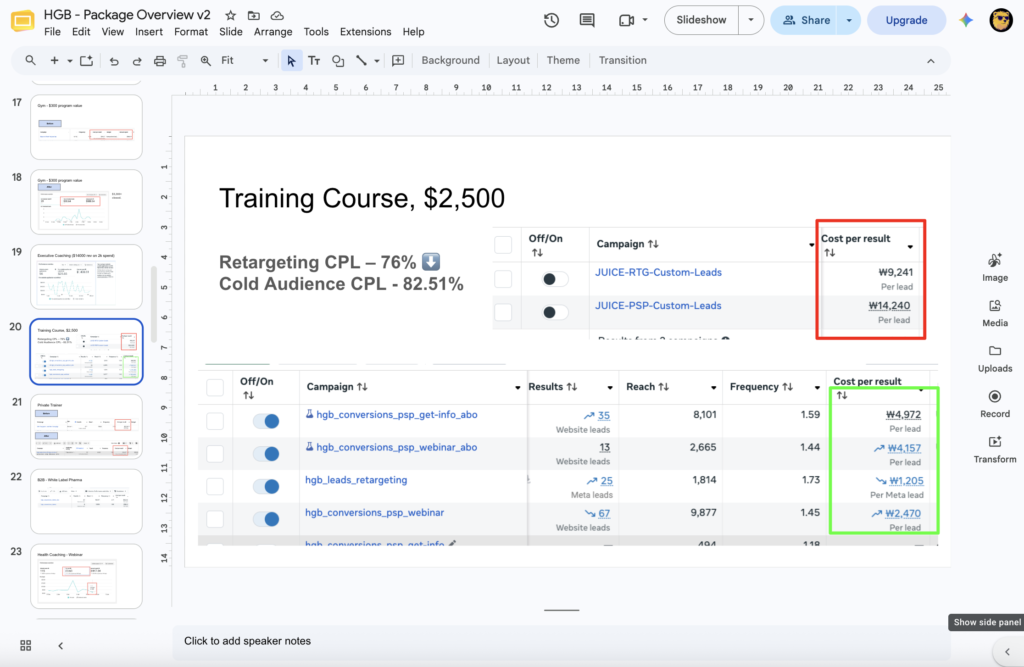
This is also when I started my trophy case. Whenever I got a nice result or a nice message from a client, I’d take a screenshot and put it into a Google PPT, then use that when applying for new work on Upwork:
Lex also says at this stage your competence goes up over time, and I invested a lot there.
To date, I’ve put around $4,800 into Meta ads courses, maybe up to $5,000 now. I also dropped $1,000 on a coaching call about Meta ads, which really helped.
I also got a little informal sales coaching from Alan Thomas (podcast about this here), and it was a massive boost.
Looking back though, my pricing system has been fairly weak. I’m getting better at it now, publishing pricing on the Hungry Bear website but also getting better at charging for things I should. Like extra calls and so on.
The biggest mistake I’ve made here though is that I tried to push too early to level 3.
Over the years, I’ve rejected work that was reasonable, paid okay, and would have given me more case studies, just because I wanted those premium rates. I pushed too hard.
This lines up with advice from my friend Gil Gildner, micro-agency owner of Discosloth.
Basically, he mentions that having a mass volume of clients is a big way you grow in the future, because they bring referrals over time until you’re no longer reliant on anything else.
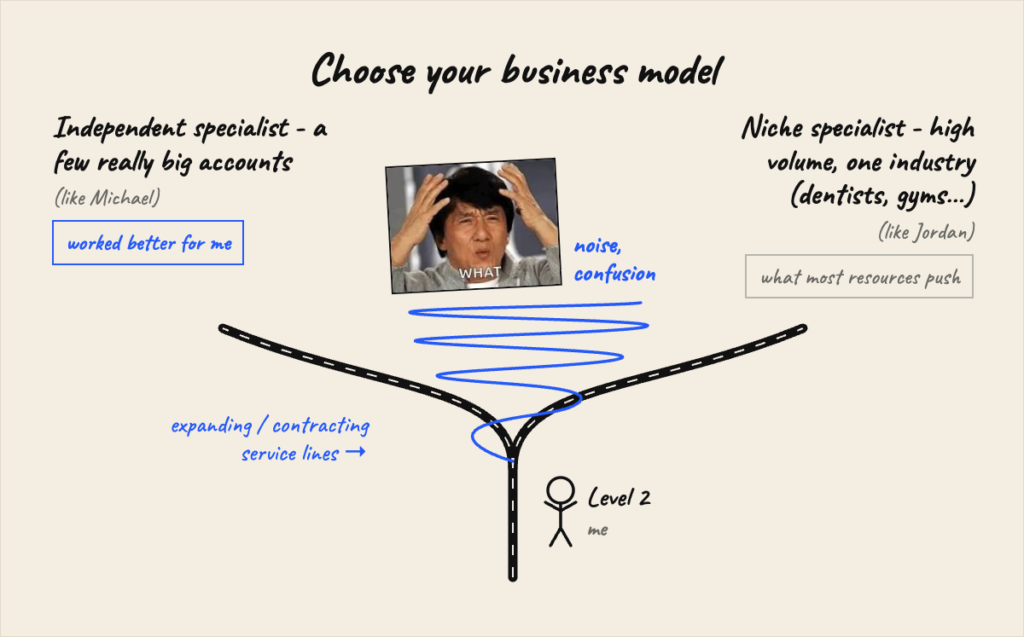
As for this stage, I also noticed it’s not just competency in the skill. It’s competency in the business model. I haven’t been able to work out which model to go with.
One option is the independent specialist who handles really big accounts, like my friend Michael Diaz. Bigwig Meta ads freelancer on YouTube.
The other is the high-volume niche specialist who dominates one industry like dentists or gyms, which is what my mate Jordan did.
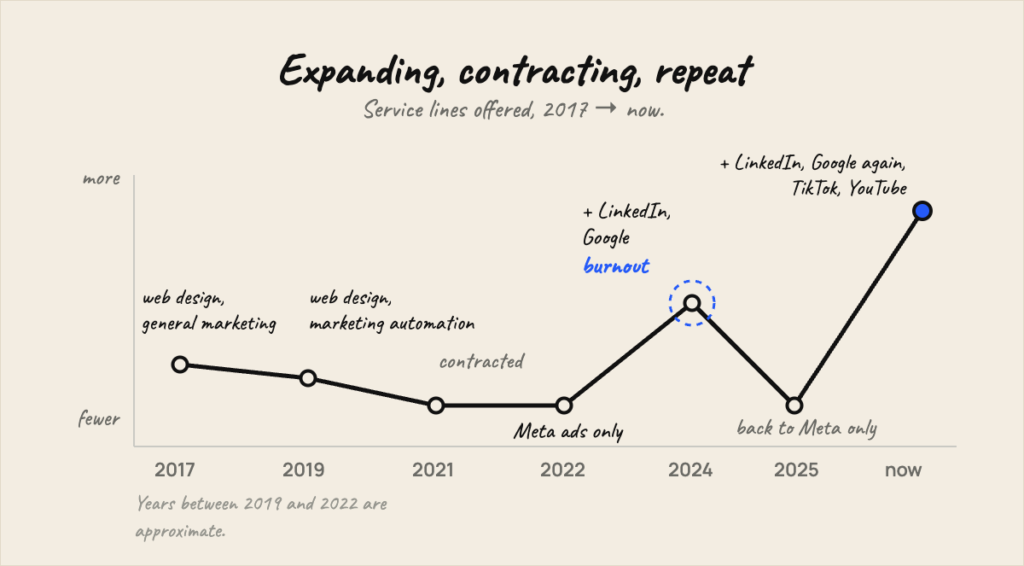
I’ve tried both approaches. I’ve been through periods of expanding my service lines and contracting them, and that hasn’t always been straightforward for me. It’s led me to burnout in the past.
Anyway, if I did level 2 afresh, here’s what I’d do:
- I’d accept most of the work I could, and only reject the jobs that clearly weren’t going to work, rather than rejecting everything below my ideal price in order to take Gil’s point seriously: volume matters.
- I’d still get my systems solid, because that part paid off.
- I’d still pay for skills. A single good coaching call can be worth more than a course.
- I’d keep chipping away at content and case studies, which I’d have ideally started from day 1.
Level 3: expert (inbound, high rates). Where I’m trying to break in now
For the 3rd level, expert, Lex says to stop chasing clients and let them prove themselves to you, shifting from sending proposals to inbound via Upwork search. He also says to build an ecosystem beyond Upwork, like a website and business email, and only take high-quality clients in your niche.
This is the stage I’m trying to get into.
Thankfully, I’m at the point where a lot of my work comes from referrals. Right now it’s roughly 95/5 network to content. But my rates aren’t the highest.
Networking is something Lex didn’t mention, but for me it’s carried the most weight.
In the beginning, and even now, I’ve spent a lot of time starting, maintaining and building relationships. For the most part, trying to connect with people I actually want to be friends with has worked. It’s been a massive growing asset that seems to have matured well over the years.
The trophy case still exists too, though I don’t use it for Upwork applications anymore.
And now that I’m trying to break into that 3rd level for the highest rates, I’m noticing that so much of the inbound for others comes from content. Which I neglected, for years.
Lots of my friends are extremely skilled, definitely high expert level in competence, but they don’t have that inbound engine for whatever reason. Almost all of them are trying to focus on it now.
Maybe it was way easier to build 10 years ago than it is now, but I think if you asked them, they’d probably regret not doing it earlier.
The ones who’ve hit level 3 and are doing really well all have that content engine, the inbound, built out. My friend Michael Diaz has a great YouTube channel which, as far as I know, provides him all the work he can handle… and more.
So I’m working on it now: LinkedIn, YouTube, and my newsletter.
And apart from taking content more seriously I’m trying to get better at pricing, and collecting reviews more deliberately.
My guess is that by the time I fully arrive at level three, it’ll be something like 70/30 content to network.
Sadly, I’m also still undecided on the business model. The independent specialist route has worked better for me, even though most of the resources seem to be about the niche route.
On the other hand, it’s worked well for me, so why fight it? I’m not sure yet how to make that decision.
Anyway, that’s been my journey so far. Obviously I can’t tell anyone how to crack level 3 but hopefully my notes on levels 1 and 2 have helped.
Let’s check in later on and see whether I managed to break into level 3, too. For my experienced friends, if you have any suggestions or comments please feel free to share them below so everyone can benefit :-).


