This year I've been on a journey of seeing how much AI can turn my micro-agency from human-run to an Infrastructure Operator model. The idea is that instead of building an agency that grows by headcount, you dig down into the tools and skills, building a machine beneath you.
And in the first two weeks, I managed to automate about 17 hrs of work.
But now I've hit my first real snags.
People don't want another thing to log into
Despite spending a chunk of time on design and development of what my hare brain thought was an easy-to-use and intuitive system for seeing exactly where things stood with our campaigns - people rarely logged in to see it.

I'd even get questions such as, "What do you want me to do now?" on Slack, when the task list of "Items to approve" sat lonely on the app, as close to flashing lights on the main screen after logging in. And with a few reminder notifications, too.
I talked to my friend Alex, one of the smartest devs I know, and found out this is actually a classic problem.
He explained that it's becoming more of a trend that people don't actually want to log into things. Because of ChatGPT, digital work is coming full circle - basically back to messages and emails.
And that makes sense.
I personally hate having more apps and if I can control something via MCP, I'd much rather do that. Even now I rarely analyse metrics directly on Meta for my clients. I ask AI to draw timeframes and compare them with other weeks to get the picture on performance.
So I unbundled the app
Thankfully, the model doesn't prescribe building and maintaining a workspace OS as the only solution. So I simply changed my automations to work with tools people already used more, rather than force a change in user behaviour.
The pieces are still the same, ultimately automations work to help me in one of these key areas:
- Copywriting
- Creative generation
- Video scripting
- Campaign management
- Campaign building
- etc
Each backed up with an SOP and tool process that delivers a lot of the heavy lifting. Per the original vision.
Just this time - when it comes to collaboration, I have the content added to the tools people are already comfortable using. For example:
- Copy in Google docs instead of CampaignDock links
- Shared Google Drive folders for the images
- Notifications drafted by Claude on my personal email, not app automation
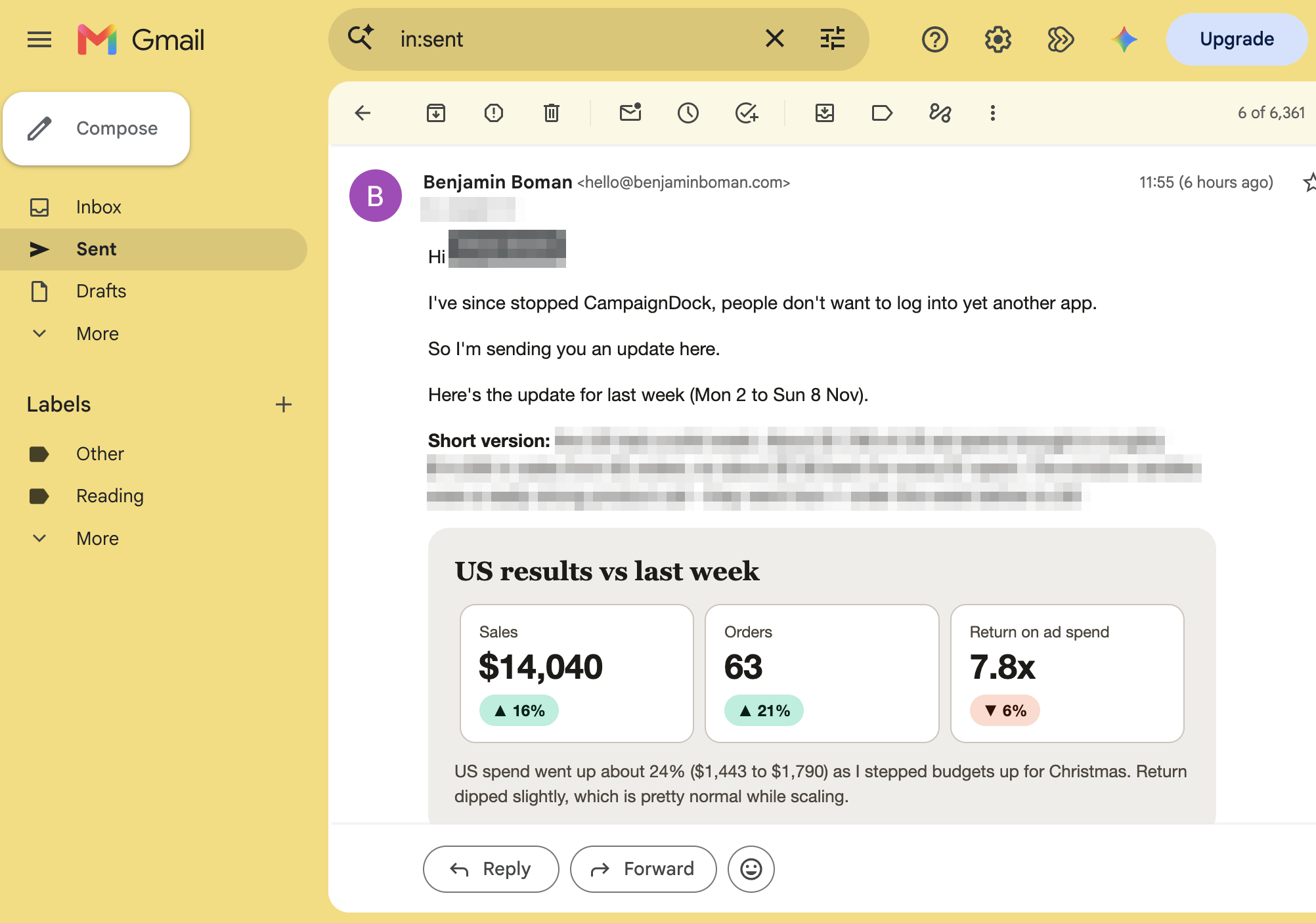
While the vision started with building an app that could automate my work in two steps by populating a task list (called Docket) and then processing Docket's approvals, building with this model doesn't necessarily mean you gotta do it via an app.
So I guess it's become a protocol.
Sadly, however, this was linked to an even snaggier problem.
Incomplete context made my AI system go the wrong way, faster
It was hard to notice this one in the beginning, because early on, things sailed through smoothly.
AI would populate the Docket task list every morning with action ideas that it understood how to do. I'd tick them off, and it would execute them in the morning. Brilliant.
But slowly, things started going off the rails. AI kept recommending ideas that were too late, or the situation had changed so the judgement was off.
And it wasn't AI's fault, it just didn't have the right context.
I missed recording a few client calls here and there. And some clients messaged me on channels that weren't discoverable by AI, like personal Instagram, private Slack channels or even WhatsApp 🤮.
This made my Docket slowly fill up with ideas based on old data, or missing context. And worse, doing this daily, it started to build up to the point where I was spending a chunk of time clearing it and trying to update the context.
Though when it had a clear read on what to do, it mostly worked in the right direction. Starting tasks that were genuinely helpful.
But at this point, it's literally faster to simply tell it what to do and let it auto-complete from there.
I'd built a pedestal, but not taught the monkey
Funnily enough, the problem matches an idea called Finding the Monkey in Annie Duke's book Quit.
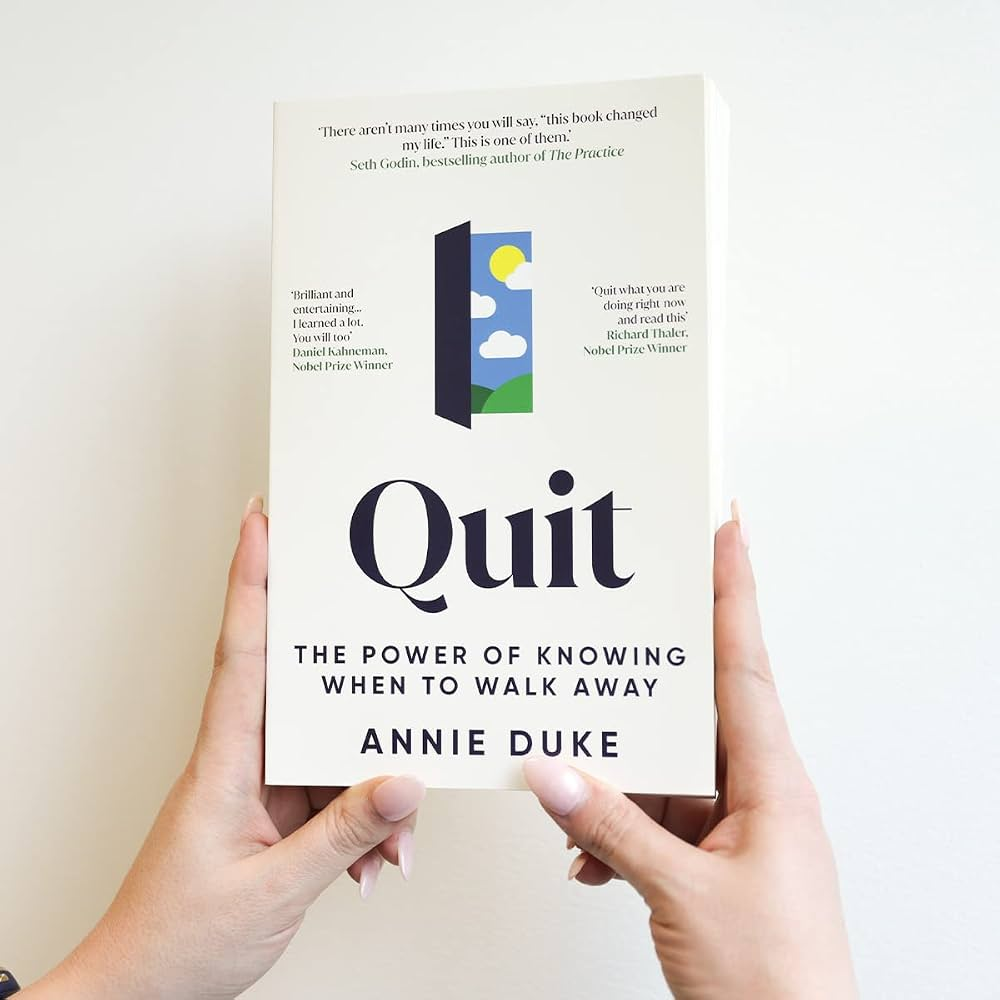
She explains that when tackling difficult projects, like teaching a monkey to juggle flaming torches on a pedestal, there are two kinds of problems:
- Easy to solve, like building the pedestal the monkey stands on.
- Hard to solve, like teaching the monkey.
And as she points out, people can fool themselves that they're making significant progress when they've simply done the easy bits - like building the pedestal, rather than things that will actually move the needle. Like teaching the monkey to juggle the flaming torches.
And getting AI to make the right call with incomplete context is the monkey.
Honestly, I'm not even sure this problem is solvable any time soon. Because it's not about the AI - it's about data input.
For now, thankfully, this project protocol is still shaving hours off the week's workload. But it hasn't turned into anything more than what everyone else is doing right now - automating the labour part of their work.
 Benjamin Boman
Responses (0)