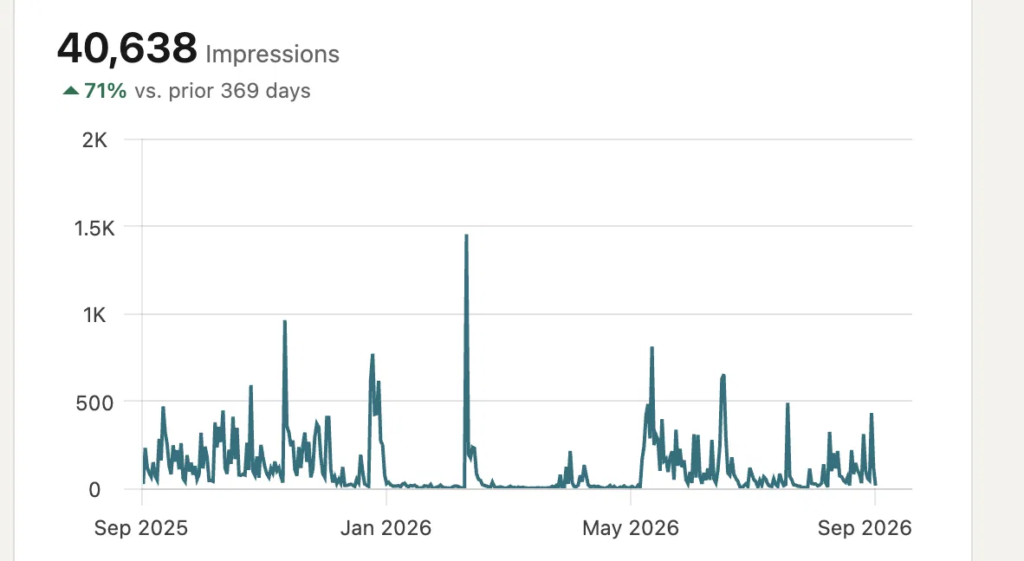
<?xml version="1.0" encoding="utf-8"?><feed xmlns="http://www.w3.org/2005/Atom" xml:lang="en"><generator uri="https://jekyllrb.com/" version="4.4.1">Jekyll</generator><link href="https://benjaminboman.com/feed.xml" rel="self" type="application/atom+xml" /><link href="https://benjaminboman.com/" rel="alternate" type="text/html" hreflang="en" /><updated>2026-10-23T15:12:06+00:00</updated><id>https://benjaminboman.com/feed.xml</id><title type="html">Benjamin Boman</title><subtitle>Freelance Facebook ads manager and marketer, currently traveling in SE Asia.</subtitle><author><name>Benjamin Boman</name></author><entry><title type="html">490 days of LinkedIn self-promo: What the numbers show</title><link href="https://benjaminboman.com/linkedin-day-490/" rel="alternate" type="text/html" title="490 days of LinkedIn self-promo: What the numbers show" /><published>2026-09-23T10:09:18+00:00</published><updated>2026-10-02T10:08:40+00:00</updated><id>https://benjaminboman.com/linkedin-day-490</id><content type="html" xml:base="https://benjaminboman.com/linkedin-day-490/"><![CDATA[<figure class="wp-block-image size-large"><img src="/wp-content/uploads/2026/09/image-4-1024x561.png" alt="" class="wp-image-763" /><figcaption class="wp-element-caption">Two breaks due to burnout or unwell.</figcaption></figure>

<p>It's been a while since the last update. Back at <a href="/linkedin-day-170/" data-type="post" data-id="202">day 170</a>, I said I was well and truly in the swing of things, knocking out a week of posts in about an hour, and that LinkedIn had led to "only a sprinkle of business opportunities."</p>

<p>So I figured it was time to pull the numbers and see what actually happened over the past year.</p>

<hr class="wp-block-separator has-alpha-channel-opacity" />

<h3 class="wp-block-heading">What's happened since day 170</h3>

<ul class="wp-block-list"><li>I kept roughly the same 3 types of posts: Meta ad news, tips and tutorials on Meta ads, and build-in-public stuff about what's going on with my business. The occasional case study too, but not many.</li>

<li>Oct to Dec 2025 was my best stretch. About 5-6k impressions a month and 70-120 new followers a month.</li>

<li>Then from around mid-January to late May 2026, I basically stopped. Burn out and I was unwell. You can see it pretty clearly in the graph above - a flatline in impressions.</li>

<li>I picked it back up around June and have been posting on and off since.</li>
</ul>

<hr class="wp-block-separator has-alpha-channel-opacity" />

<h3 class="wp-block-heading">Return on effort</h3>

<p>Over the last 12 months (Sep 2025 to Sep 2026):</p>

<ul class="wp-block-list"><li>~40,600 impressions</li>

<li>~12,800 people reached</li>

<li>~520 new followers (1,493 total)</li>

<li>Engagement rate around 3-4.5% in the months I was consistent</li>
</ul>

<p>Those are the vanity numbers. </p>

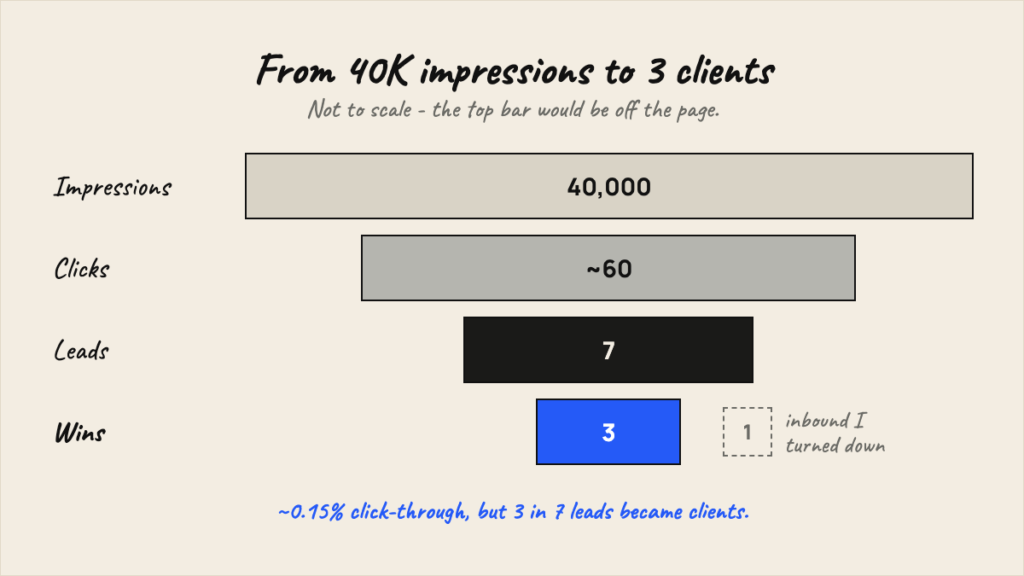
<p>The part I was more curious about was whether any of it turned into actual work. So I analyzed my CRM and emails to traced where each lead came from this year for LinkedIn and found out:</p>

<figure class="wp-block-image size-large"><img src="/wp-content/uploads/2026/09/linkedin-awareness-to-leads-1024x576.png" alt="" class="wp-image-764" /></figure>

<ul class="wp-block-list"><li>I got ~60 clicks to my websites (47 to this blog, 12 to Hungry Bear). Probably undercounted, since the LinkedIn app tends to hide where traffic comes from, but even if you doubled it, it's microscopic.</li>

<li>7 leads that started on LinkedIn.</li>

<li>3 of those turned into paid work.</li>
</ul>

<p>These all came through DMs and conversations that started on LinkedIn itself. Looking back, this is pretty expected since I rarely plugged my website directly.</p>

<hr class="wp-block-separator has-alpha-channel-opacity" />

<h3 class="wp-block-heading">Takeaways on post types</h3>

<p><strong>Meta ad news</strong></p>

<figure class="wp-block-image size-large"><img src="/wp-content/uploads/2026/09/image-6-1024x984.png" alt="" class="wp-image-768" /></figure>

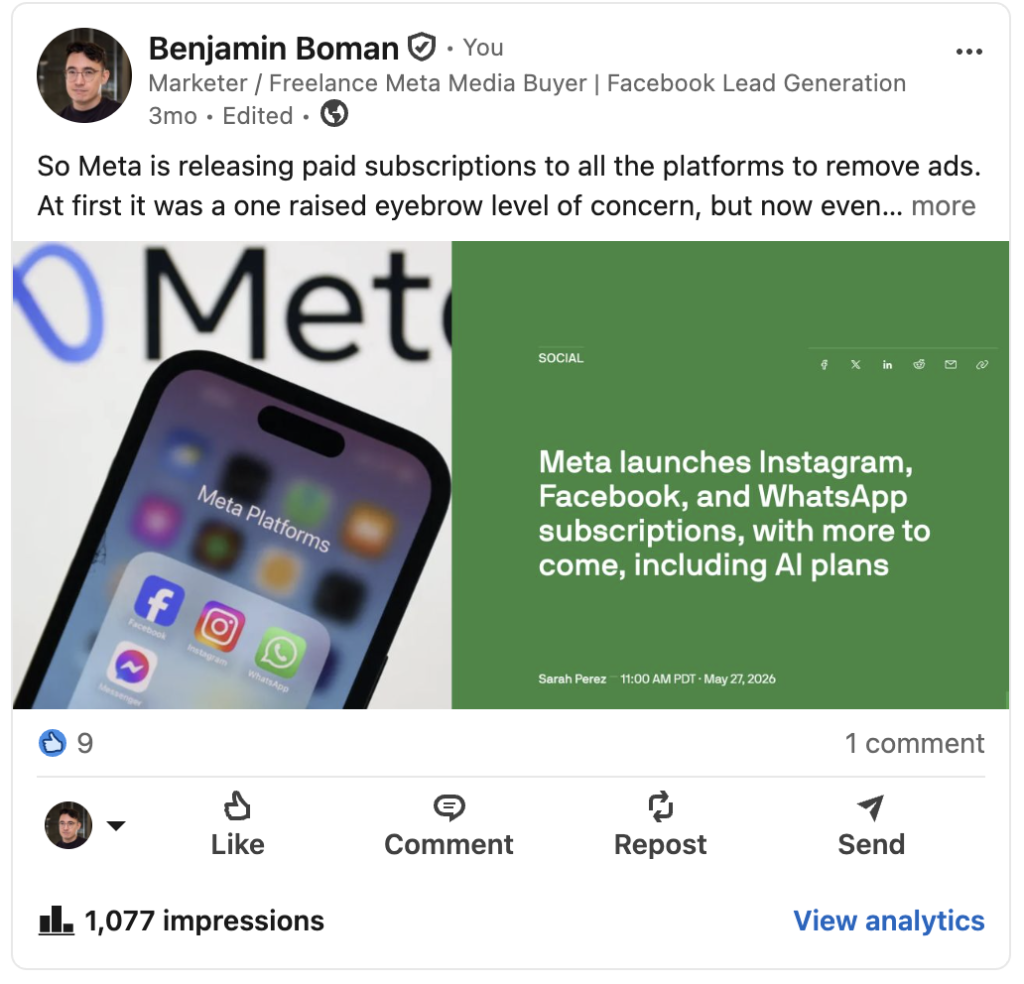
<ul class="wp-block-list"><li>By far the most reach. My top 3 posts by impressions were all news: 3.1k, 2.5k and 1.6k.</li>

<li>But almost nobody commented. 0-3 comments on posts seen by thousands of people tho...</li>

<li>The people seeing them also looked more like other ad people (folks doing Meta, Google, and big agencies) than potential clients. Which makes sense, but isn't useful reach.</li>
</ul>

<p><strong>Tips and tutorial posts</strong></p>

<ul class="wp-block-list"><li>The weakest on both reach and engagement! A case study where cold lead costs dropped ~91% got about 300 views.</li>
</ul>

<p><strong>Build in public / journey posts</strong></p>

<ul class="wp-block-list"><li>These actually get THE highest engagement rates of any posts. Usually 5-6% plus. The day 170 post was my 2nd most engaged post of the year.</li>
</ul>

<p><strong>Asking my network a genuine question</strong></p>

<ul class="wp-block-list"><li>One example, my post asking what newsletters are actually for these days, got 39 comments. More than anything else by a mile. I have a feeling there's something to this because LinkedIn wants conversation - not necessarily self promotion.</li>

<li>Tacking "anyone else seeing/doing/thinking about this?" onto the end of news post or other tip/tutorials didn't have much effect. I think the difference is that it has to be a real question I'm actually stuck on where my friends jump in to help.</li>
</ul>

<p><strong>Memes</strong></p>

<figure class="wp-block-image size-large"><img src="/wp-content/uploads/2026/09/image-5-955x1024.png" alt="" class="wp-image-767" /></figure>

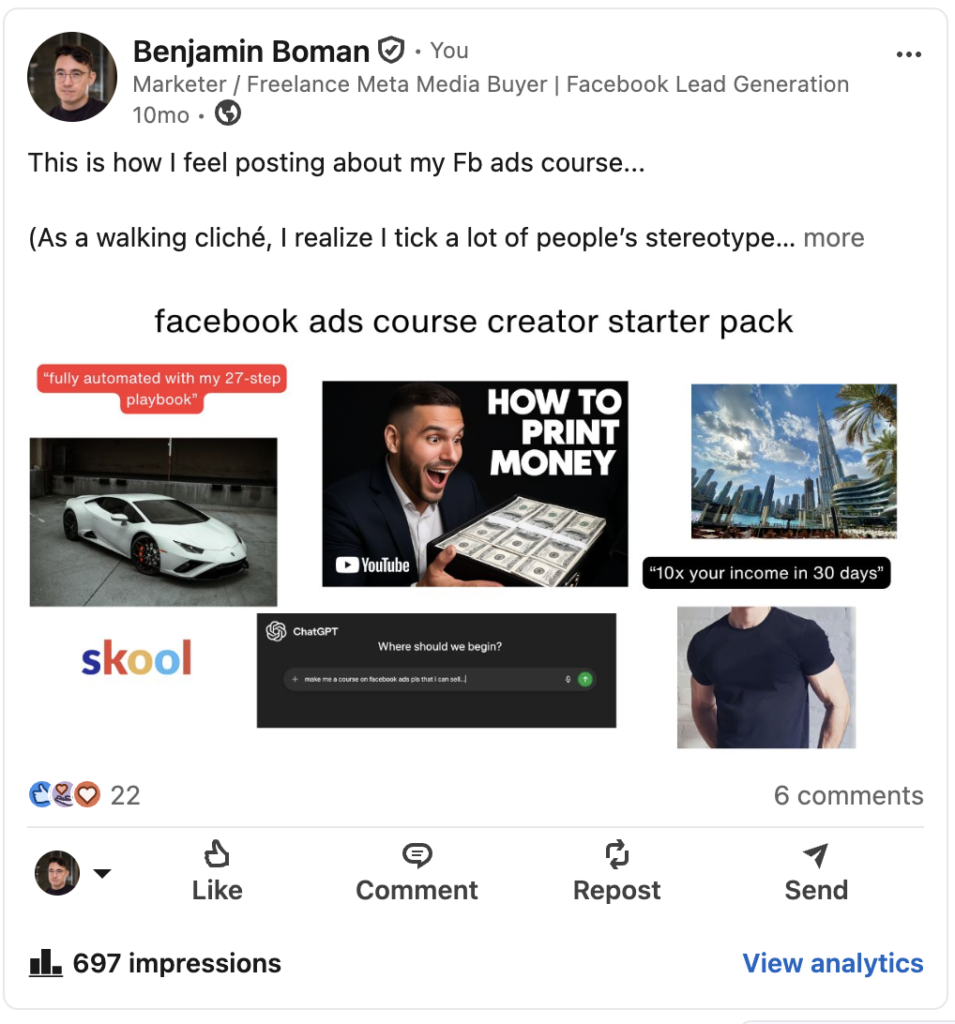
<ul class="wp-block-list"><li>Pretty low effort, surprisingly solid engagement.</li>
</ul>

<p><strong>PDF / carousel posts</strong></p>

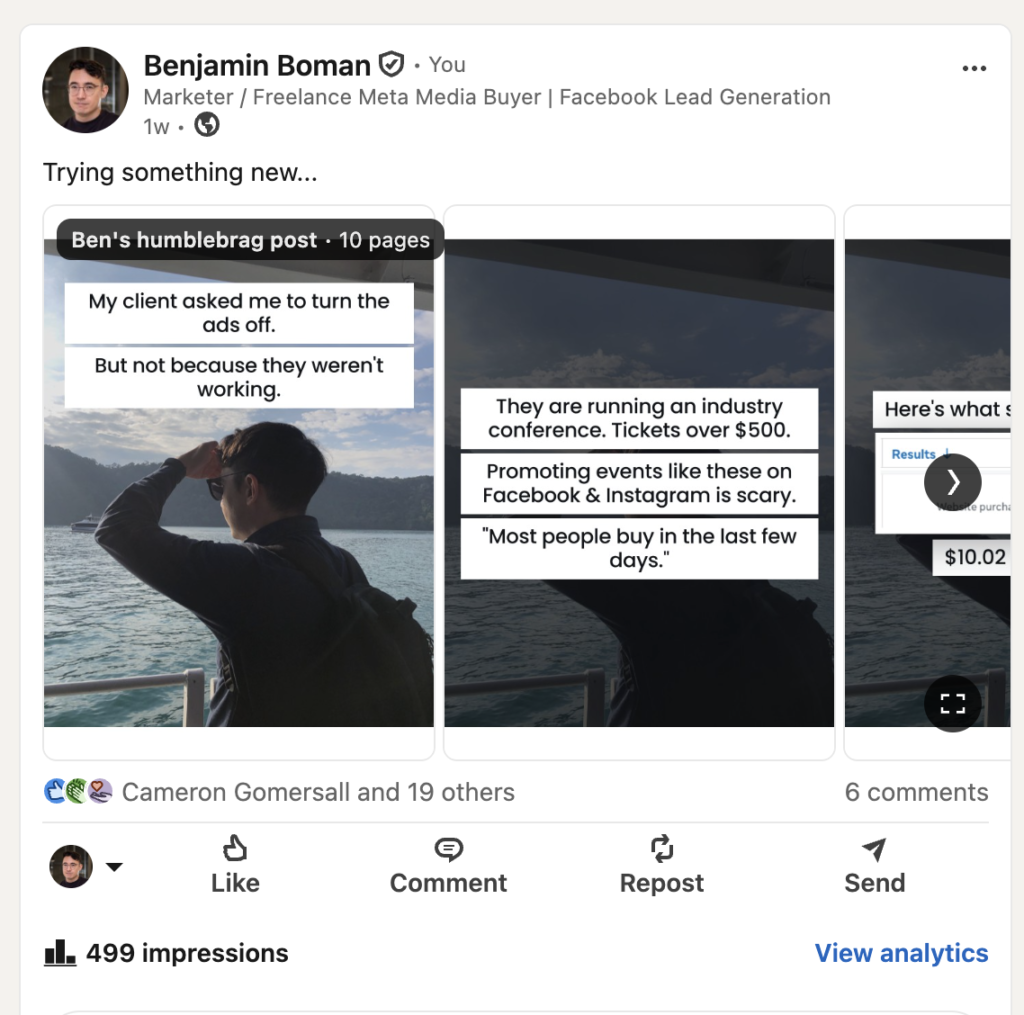
<ul class="wp-block-list"><li>I made some tehcnical news. updates and recently "trying something new…" (a heavy personal brand style post) all landed around 500 views.</li>

<li>The humblebrag one did best on engagement: 26 engagements and 6 comments, one of my better rates lately.</li>
</ul>

<figure class="wp-block-image size-large"><img src="/wp-content/uploads/2026/09/image-2-1024x1015.png" alt="" class="wp-image-761" /></figure>

<p><strong>Processes</strong></p>

<ul class="wp-block-list"><li>Previously I used Google Keep to make idea bank: I ended up dropping it. Recently I've just riffered of things I see on Twitter and online communities.</li>

<li>Connecting instead of doom-scrolling: I dropped this too, and I suspect it cost me. June 2026 got about the same reach as October 2025 (~5.8k vs ~5.7k impressions) but only about half the new followers (66 vs 124). I can't prove it, but my guess is that reach without new connections doesn't grow much.</li>

<li>Commenting instead of DMing: Just because I'm lazy...</li>
</ul>

<hr class="wp-block-separator has-alpha-channel-opacity" />

<h3 class="wp-block-heading">Where to from here?</h3>

<p>Honestly, I'm not sure what direction I take LinkedIn from here.</p>

<p><strong>The thing that stands out most is how vulnerable it was to me taking breaks. Stop posting and you basically never existed on the platform, as you can see in the graph at the beginning.</strong></p>

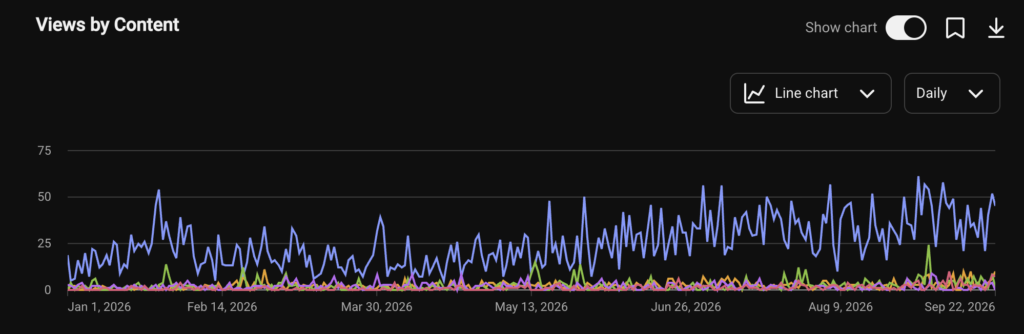
<p>Meanwhile, YouTube has just chugged along in the background. When I was burned out or sick, there was almost no noticeable difference.</p>

<figure class="wp-block-image size-large"><img src="/wp-content/uploads/2026/09/image-3-1024x334.png" alt="" class="wp-image-762" /></figure>

<p>So I'm leaning towards spending the time on YouTube instead, where the work seems to keep working even when I can't.</p>

<p>But if so, LinkedIn will probably stay the a place to have conversations and stay visible to my existing network, and plug a link or two. </p>

<p>I'm open to being wrong here, though. If you've found something similar (or the opposite) with LinkedIn vs YouTube, I'd love to hear about it in the comments.</p>

<p>See you in the next update 🫡.</p>]]></content><author><name>Benjamin Boman</name></author><category term="Uncategorized" /><summary type="html"><![CDATA[Two breaks due to burnout or unwell.]]></summary></entry><entry><title type="html">The 3 levels of freelancing</title><link href="https://benjaminboman.com/3-levels-freelancing/" rel="alternate" type="text/html" title="The 3 levels of freelancing" /><published>2026-09-21T05:41:27+00:00</published><updated>2026-09-21T05:41:27+00:00</updated><id>https://benjaminboman.com/3-levels-freelancing</id><content type="html" xml:base="https://benjaminboman.com/3-levels-freelancing/"><![CDATA[<p>If freelancing were a game, what would be the map? And has anyone written the guide?</p>

<p>I came across something like that back in 2022: Lex DeVille's video on the <a href="https://youtu.be/iyU4DqGGSb8?si=hH4YqG1ktnchssgj">three levels of Upwork</a>. Even though it was just about Upwork, looking back, I think it gives clues to the main freelancer arc, not just that platform.</p>

<p><em><strong>The TLDR of his video is:</strong> in the beginning, you have to be really scrappy and take whoever you can. In the middle, you try to raise your rates to something livable, not just bottom of the barrel, but you still have to hustle. Then at the end, it shifts to inbound and mostly high rates.</em></p>

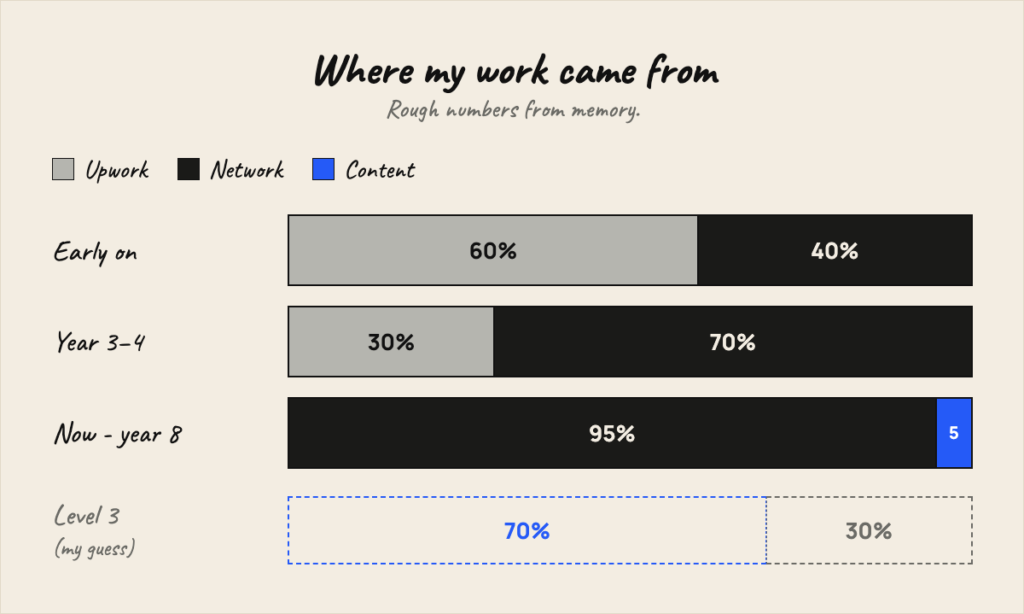
<figure class="wp-block-image size-large"><img src="/wp-content/uploads/2026/09/freelance-work-source-over-time-1024x614.png" alt="" class="wp-image-747" /></figure>

<p>I can see that arc in my own freelance work too:</p>

<ul class="wp-block-list"><li><strong>In the beginning:</strong> roughly 60/40 Upwork to network - low rates</li>

<li><strong>By year 3 or 4:</strong> roughly 30/70 Upwork to network, better rates - not rich yet</li>

<li><strong>2026+:</strong> roughly 0/95/5 Upwork, network to content - sometimes great rates</li>
</ul>

<p>Here's roughly what Lex says at each level and what I actually did, including the mistakes, in case it's useful for anyone freelancing themselves, especially with digital skills - less so for consultants I guess.</p>

<hr class="wp-block-separator has-alpha-channel-opacity" />

<h3 class="wp-block-heading"><strong>Level 1: beginner (get scrappy)</strong></h3>

<p>Lex says to aim to land your first gig within one to two months with a complete, professional profile and portfolio, plus a foot-in-the-door offer by being cheap. He also says to lean on any existing credibility you have, like education, volunteer work, or certifications.</p>

<p>For me, I started by calling in favors and taking on any kind of messy work I could get my hands on, even if it wasn't necessarily on target.</p>

<p>Partly that was for Upwork reviews, but it was also for case studies and proof in general.</p>

<p>This is where I see some of my friends have a real bad time. They often try to charge premium rates from the get go. Honestly, I feel like you should be scrappy and take on whoever you can in the beginning, to get those case studies and that initial leverage.</p>

<p>I also started building my network here. <a href="/how-to-network/" data-type="post" data-id="46">My approach</a> is basically trying to make connections with people I actually want to be friends with.</p>

<p>As a side note: I got advice from <a href="https://www.luanwise.co.uk/">Luan Wise</a> in the UK, my original freelance mentor, to create a website and start publishing content.</p>

<p>Which I didn't do, obviously, until fairly recently. (That was a major error).</p>

<p>Looking back, I should have been a lot more purposeful about collecting reviews from the very beginning, too. I wish I'd kept a trophy case of result screenshots and nice messages while I was doing all that broad work, because a lot of early proof never got captured. </p>

<p>I also didn't put any effort into learning content and self-promotion skills, or sales. I never realized how much I sucked at it.</p>

<p>So if I did level 1 again:</p>

<ul class="wp-block-list"><li>I'd still be scrappy and take whoever I could, and not charge premium rates yet.</li>

<li>I'd start a trophy case from the first job, with screenshots of results and nice client messages in one place, even while the work was broad and not on target.</li>

<li>I'd ask for the review every time.</li>

<li>I'd do a little content and self-promotion from the very beginning, even if it was rough.</li>

<li>I'd get some sales coaching early, even informal.</li>

<li>I'd still network with people I'd genuinely want to be friends with, which I did do.</li>
</ul>

<hr class="wp-block-separator has-alpha-channel-opacity" />

<h3 class="wp-block-heading"><strong>Level 2: intermediate (get livable rates, less hustling)</strong></h3>

<p>For months three to six, Lex says to raise your rates (he suggests $15–55/hr) and look more professional with systems like Calendly and digital contracts. He also says to keep testing your profile title, bio and pricing.</p>

<p>For level 2, I did pretty much what he suggested. </p>

<p>I raised my rates to something livable, off the bottom of the barrel, and focused on PPC and social ads. I built a lot of systems, like contract templates, some pricing packages, a proper site, etc. </p>

<p>The overall structure of my work got very strong here.</p>

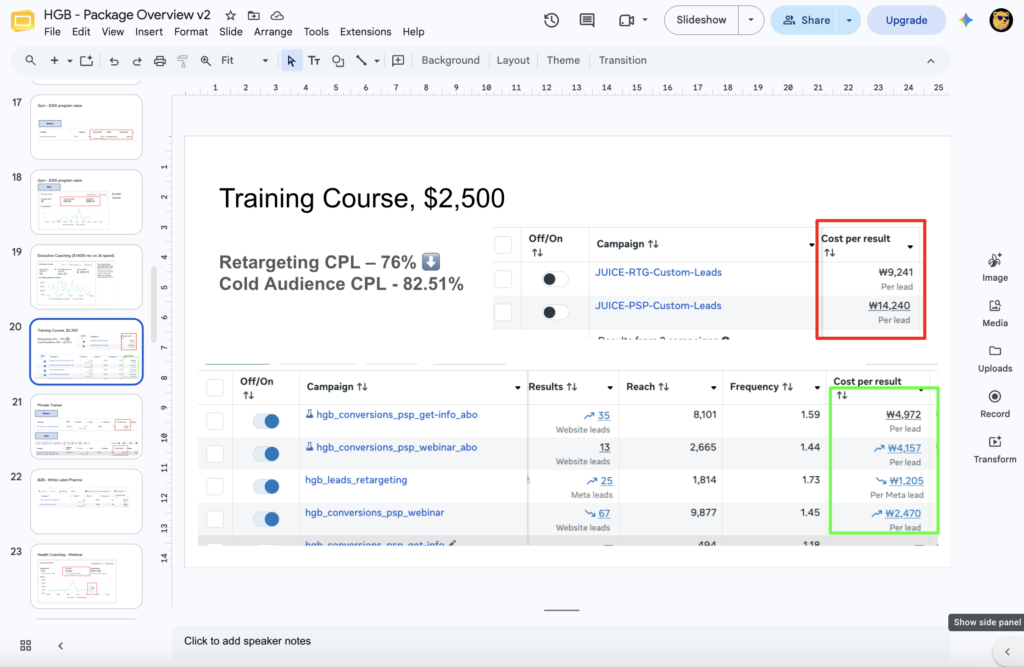
<p>This is also when I started my trophy case. Whenever I got a nice result or a nice message from a client, I'd take a screenshot and put it into a Google PPT, then use that when applying for new work on Upwork:</p>

<figure class="wp-block-image size-large"><img src="/wp-content/uploads/2026/09/image-1024x667.png" alt="" class="wp-image-750" /></figure>

<p>Lex also says at this stage your competence goes up over time, and I invested a lot there. </p>

<p>To date, I've put around $4,800 into Meta ads courses, maybe up to $5,000 now. I also dropped $1,000 on a coaching call about Meta ads, which really helped. </p>

<p>I also got a little informal sales coaching from <a href="https://revpact.io/">Alan Thomas</a> (podcast about this <a href="/alan-thomas-agency-sales/">here</a>), and it was a massive boost.</p>

<p>Looking back though, my pricing system has been fairly weak. I'm getting better at it now, publishing pricing on the Hungry Bear website but also getting better at charging for things I should. Like extra calls and so on.</p>

<p><strong>The biggest mistake I've made here though is that I tried to push too early to level 3. </strong></p>

<p>Over the years, I've rejected work that was reasonable, paid okay, and would have given me more case studies, just because I wanted those premium rates. I pushed too hard.</p>

<p>This lines up with advice from my friend Gil Gildner, micro-agency owner of <a href="https://www.discosloth.com/">Discosloth</a>. </p>

<p>Basically, he mentions that having a mass volume of clients is a big way you grow in the future, because they bring referrals over time until you're no longer reliant on anything else.</p>

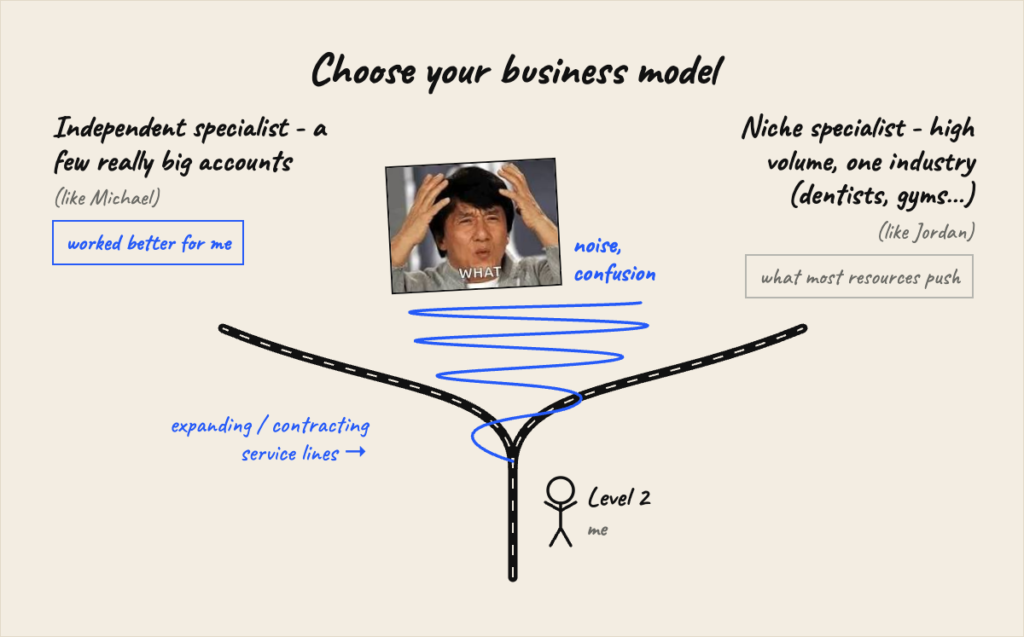
<p>As for this stage, I also noticed it's not just competency in the skill. It's competency in the business model. I haven't been able to work out which model to go with. </p>

<p>One option is the independent specialist who handles really big accounts, like my friend Michael Diaz. Bigwig Meta ads freelancer on YouTube.</p>

<p>The other is the high-volume niche specialist who dominates one industry like dentists or gyms, which is what my mate Jordan did. </p>

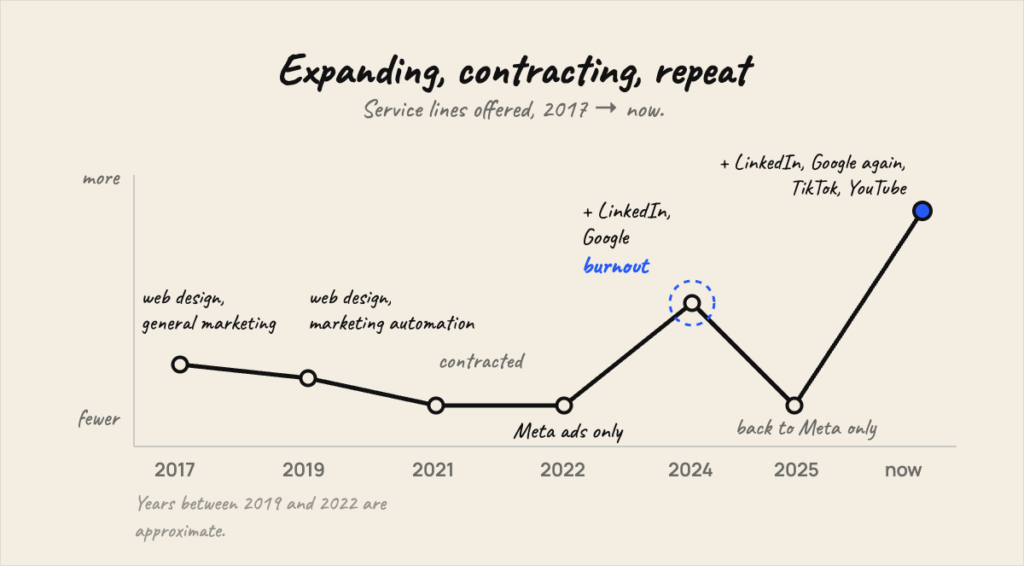
<p>I've tried both approaches. I've been through periods of expanding my service lines and contracting them, and that hasn't always been straightforward for me. It's led me to <a href="/freelance-year-7/" data-type="post" data-id="40">burnout</a> in the past.</p>

<figure class="wp-block-image size-large"><img src="/wp-content/uploads/2026/09/media-buyer-business-model-1024x637.png" alt="" class="wp-image-748" /></figure>

<p>Anyway, if I did level 2 afresh, here's what I'd do:</p>

<ul class="wp-block-list"><li>I'd accept most of the work I could, and only reject the jobs that clearly weren't going to work, rather than rejecting everything below my ideal price in order to take Gil's point seriously: volume matters.</li>

<li>I'd still get my systems solid, because that part paid off.</li>

<li>I'd still pay for skills. A single good coaching call can be worth more than a course.</li>

<li>I'd keep chipping away at content and case studies, which I'd have ideally started from day 1.</li>
</ul>

<hr class="wp-block-separator has-alpha-channel-opacity" />

<h3 class="wp-block-heading"><strong>Level 3: expert (inbound, high rates). Where I'm trying to break in now</strong></h3>

<p>For the 3rd level, expert, Lex says to stop chasing clients and let them prove themselves to you, shifting from sending proposals to inbound via Upwork search. He also says to build an ecosystem beyond Upwork, like a website and business email, and only take high-quality clients in your niche.</p>

<p>This is the stage I'm trying to get into. </p>

<p>Thankfully, I'm at the point where a lot of my work comes from referrals. Right now it's roughly 95/5 network to content. But my rates aren't the highest.</p>

<p>Networking is something Lex didn't mention, but for me it's carried the most weight.</p>

<p>In the beginning, and even now, I've spent a lot of time starting, maintaining and building relationships. For the most part, trying to connect with people I actually want to be friends with has worked. It's been a massive growing asset that seems to have matured well over the years.</p>

<p>The trophy case still exists too, though I don't use it for Upwork applications anymore.</p>

<p>And now that I'm trying to break into that 3rd level for the highest rates, I'm noticing that so much of the inbound for others comes from content. Which I neglected, for <em>years</em>.</p>

<p><strong>Lots of my friends are extremely skilled, definitely high expert level in competence, but they don't have that inbound engine for whatever reason. Almost all of them are trying to focus on it now. </strong></p>

<p>Maybe it was way easier to build 10 years ago than it is now, but I think if you asked them, they'd probably regret not doing it earlier.</p>

<p>The ones who've hit level 3 and are doing really well all have that content engine, the inbound, built out. My friend Michael Diaz has a great YouTube channel which, as far as I know, provides him all the work he can handle... and more.</p>

<p>So I'm working on it now: <a href="/linkedin-day-170/" data-type="post" data-id="202">LinkedIn</a>, <a href="/100-youtube-subscribers/" data-type="post" data-id="83">YouTube</a>, and my newsletter. </p>

<p>And apart from taking content more seriously I'm trying to get better at pricing, and collecting reviews more deliberately.</p>

<p>My guess is that by the time I fully arrive at level three, it'll be something like 70/30 content to network.</p>

<figure class="wp-block-image size-large"><img src="/wp-content/uploads/2026/09/service-expansion-contraction-1024x566.png" alt="" class="wp-image-749" /></figure>

<p>Sadly, I'm also still undecided on the business model. The independent specialist route has worked better for me, even though most of the resources seem to be about the niche route. </p>

<p>On the other hand, it's worked well for me, so why fight it? I'm not sure yet how to make that decision.</p>

<hr class="wp-block-separator has-alpha-channel-opacity" />

<p>Anyway, that's been my journey so far. Obviously I can't tell anyone how to crack level 3 but hopefully my notes on levels 1 and 2 have helped.</p>

<p>Let's check in later on and see whether I managed to break into level 3, too. For my experienced friends, if you have any suggestions or comments please feel free to share them below so everyone can benefit :-).</p>]]></content><author><name>Benjamin Boman</name></author><category term="Uncategorized" /><summary type="html"><![CDATA[If freelancing were a game, what would be the map? And has anyone written the guide?]]></summary></entry><entry><title type="html">Jesse Schoberg on Business Blogging Post-AI in 2026 [#31]</title><link href="https://benjaminboman.com/jesse-schoberg-business-blogging/" rel="alternate" type="text/html" title="Jesse Schoberg on Business Blogging Post-AI in 2026 [#31]" /><published>2026-09-01T08:27:36+00:00</published><updated>2026-09-01T08:27:36+00:00</updated><id>https://benjaminboman.com/jesse-schoberg-business-blogging</id><content type="html" xml:base="https://benjaminboman.com/jesse-schoberg-business-blogging/"><![CDATA[<figure class="embed embed--spotify"><iframe src="https://open.spotify.com/embed/episode/2IZ6CIeVXUx5bAdvdmf5LV" width="100%" height="152" frameborder="0" loading="lazy" allow="autoplay; clipboard-write; encrypted-media; fullscreen; picture-in-picture" title="Spotify"></iframe></figure>

<p><a href="https://schoberg.net">Jesse Schoberg</a> is co-founder of <a href="https://dropinblog.com">DropInBlog</a>, the drop-in blog platform used by thousands of Shopify and BigCommerce brands. Jesse has been featured in Forbes, CNBC Make It, Niche Pursuits and Indie Hackers. We got into whether SEO is dead in 2026, what AI search has changed about business blogging, and where the arbitrage is right now for small brands.</p>

<hr class="wp-block-separator has-alpha-channel-opacity" />

<h3 class="wp-block-heading">Timestamps:</h3>

<ul class="wp-block-list"><li>[00:00] Is SEO dead in 2026</li>

<li>[00:04] Why top of funnel traffic is down</li>

<li>[00:08] The arbitrage window for small brands</li>

<li>[00:09] Writing getting cited with your own listicles</li>

<li>[00:12] Branding a proprietary system so AI has something to quote</li>

<li>[00:15] The offsite layer of sites</li>

<li>[00:16] What cites in AI overviews</li>

<li>[00:21] Moving a personal blog to Astro</li>

<li>[00:25] Why AI slop blogs spike then crash</li>

<li>[00:32] Example: Building the blogging channel from zero</li>
</ul>

<hr class="wp-block-separator has-alpha-channel-opacity" />

<h3 class="wp-block-heading">Key links:</h3>

<ul class="wp-block-list"><li>DropInBlog - <a href="https://dropinblog.com">dropinblog.com</a></li>

<li>Jesse's personal site - <a href="https://schoberg.net">schoberg.net</a></li>

<li>AI Cite - <a href="https://growthmethod.com/ai-site-framework/">https://growthmethod.com/ai-site-framework/</a></li>

<li>Blog Pilot - <a href="https://dropinblog.com/blog/blog-pilot/">https://dropinblog.com/blog/blog-pilot/</a></li>
</ul>]]></content><author><name>Benjamin Boman</name></author><category term="Podcast" /><summary type="html"><![CDATA[]]></summary><media:thumbnail xmlns:media="http://search.yahoo.com/mrss/" url="https://benjaminboman.com/wp-content/uploads/2026/09/Jesse-Schoberg-300x300.png" /><media:content medium="image" url="https://benjaminboman.com/wp-content/uploads/2026/09/Jesse-Schoberg-300x300.png" xmlns:media="http://search.yahoo.com/mrss/" /></entry><entry><title type="html">Trying the Infrastructure Operator Model, 2 weeks in</title><link href="https://benjaminboman.com/infrastructure-operator-model-week-2/" rel="alternate" type="text/html" title="Trying the Infrastructure Operator Model, 2 weeks in" /><published>2026-08-24T14:12:58+00:00</published><updated>2026-08-24T14:12:58+00:00</updated><id>https://benjaminboman.com/infrastructure-operator-model-week-2</id><content type="html" xml:base="https://benjaminboman.com/infrastructure-operator-model-week-2/"><![CDATA[<p>Back in March this year, my mate David shared with me this idea called the <a href="https://x.com/mike_revenue/article/2010093145527111733">Hollow Engine problem</a> by a guy called Michael Davidson on Twitter.</p>

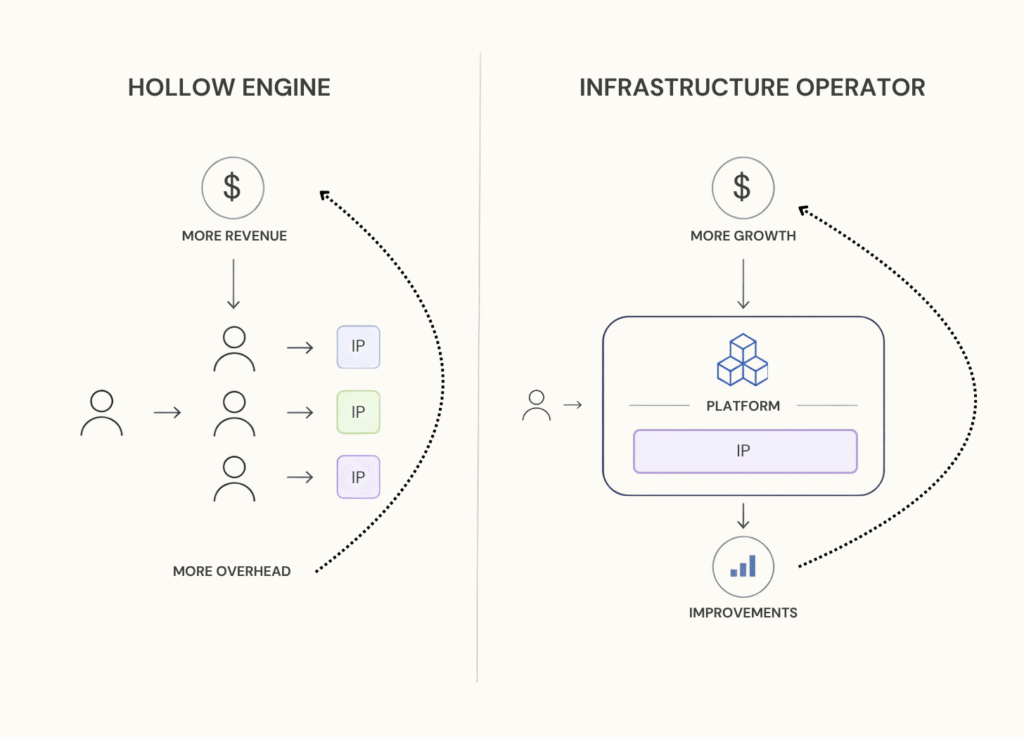
<p>The idea is that most agencies are "hollow" in that the engine for production is people. And as they grow, so do expenses, straining profit.</p>

<p>But <em>with AI</em>, smart agencies and freelancers can change to an "Infrastructure Operator Model" where we basically codify what we do into skills and procedures, let agentic AI run it, resulting in a leveraged one person business.</p>

<figure class="wp-block-image aligncenter size-large"><img src="/wp-content/uploads/2026/08/hollow-engine-vs-infra-op-1024x737.png" alt="" class="wp-image-699" /><figcaption class="wp-element-caption">Maybe not the best explanatory diagram but I think you get the idea. </figcaption></figure>

<p><strong>The engine becomes the asset.</strong></p>

<p>This set me off on an idea whether I could leverage AI tools in their current 2026 state to do this.</p>

<p>And somehow, I managed to get something scraped together and working!</p>

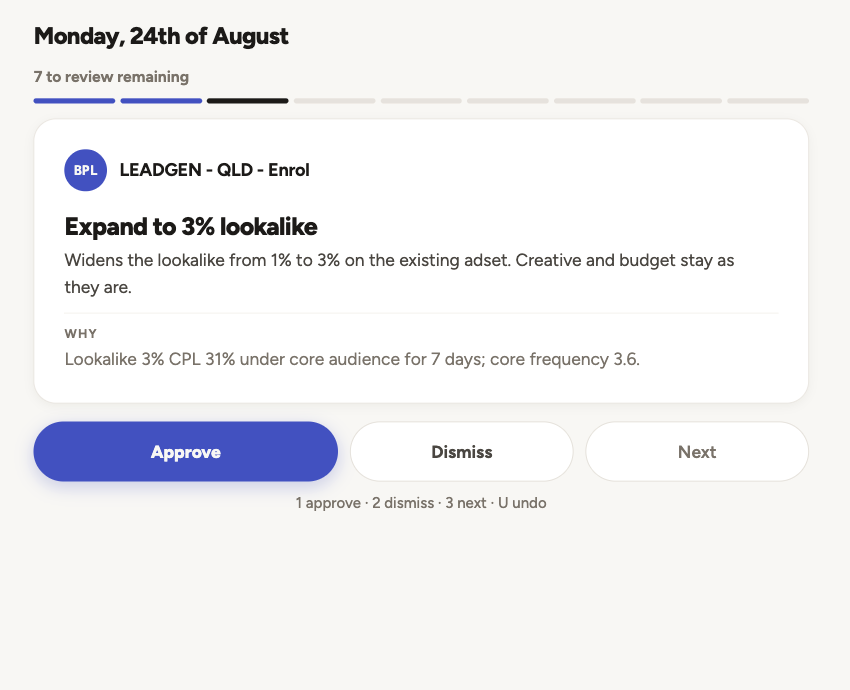
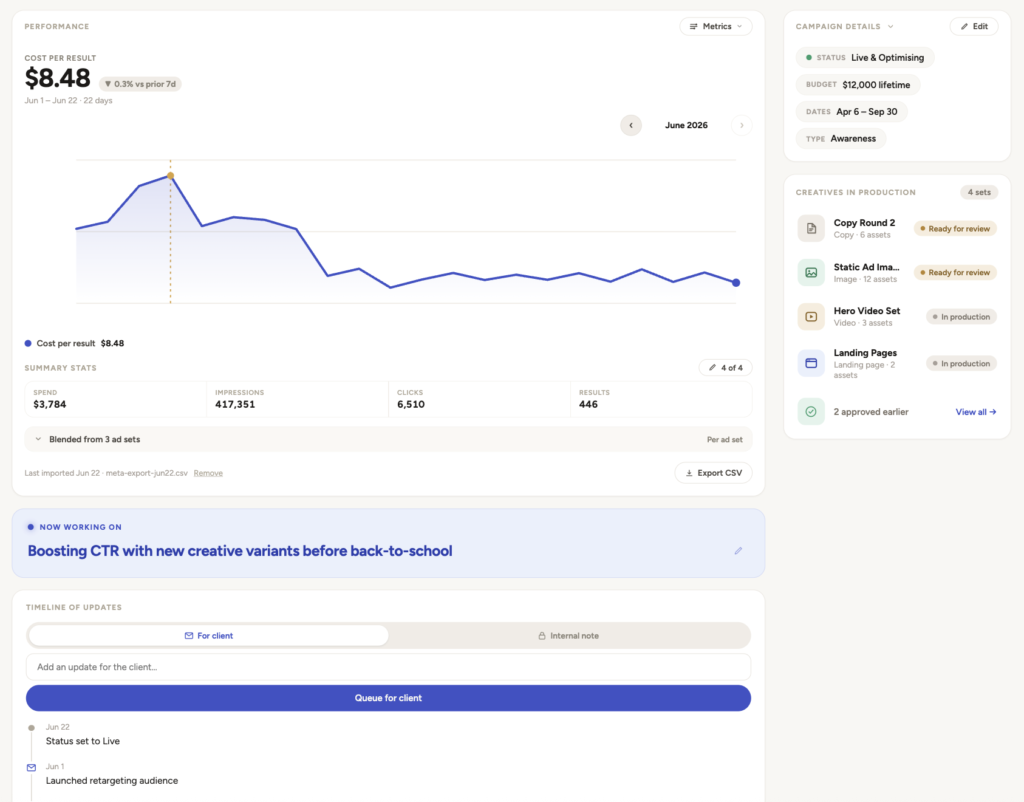
<p>Everyday, around 8:30 AM my workspace OS web-app suggests a range of tasks (that it can do) for my approval based on the context of my clients and emails etc:</p>

<figure class="wp-block-image aligncenter size-full is-resized"><img src="/wp-content/uploads/2026/08/docket-example.png" alt="" class="wp-image-703" style="aspect-ratio:1.2319078456534065;width:487px;height:auto" /><figcaption class="wp-element-caption">Should have made it swipe left or right...?</figcaption></figure>

<p>For each thing, I can approve, dismiss or skip. Works on mobile, too.</p>

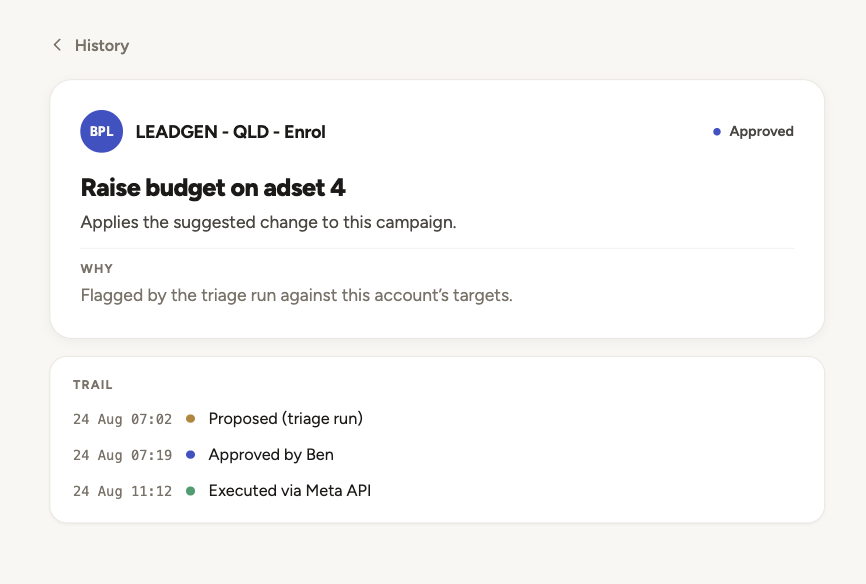
<p>Then about 60 minutes later, it will execute the approved tasks.</p>

<figure class="wp-block-image aligncenter size-full is-resized"><img src="/wp-content/uploads/2026/08/example-completed.png" alt="" class="wp-image-708" style="aspect-ratio:1.4829184179329669;width:480px;height:auto" /></figure>

<p>While it currently can't do everything, it's taking a few things off my plate to get some work life balance back.</p>

<p>Here's how it works:</p>

<h2 class="wp-block-heading">1. Collect context data</h2>

<p>Originally I thought to make the system I needed to write Claude skills for each one of my tasks. </p>

<p>So I started creating skills for everything and connected Claude to my gmail, Asana, etc and basically tried to let it rip. But the problem was - it could never really get anywhere because it lacked greater context of a client or campaign.</p>

<p><strong>Which made me realise - execution is the easy part. The real lift happens when AI can decide for itself. And to do that it needs structured data.</strong></p>

<p>So I built out the base of the app as a client context framework.</p>

<p>This includes a timeline per client and campaign:</p>

<figure class="wp-block-image size-large"><img src="/wp-content/uploads/2026/08/timeline-example-1024x802.png" alt="" class="wp-image-705" /></figure>

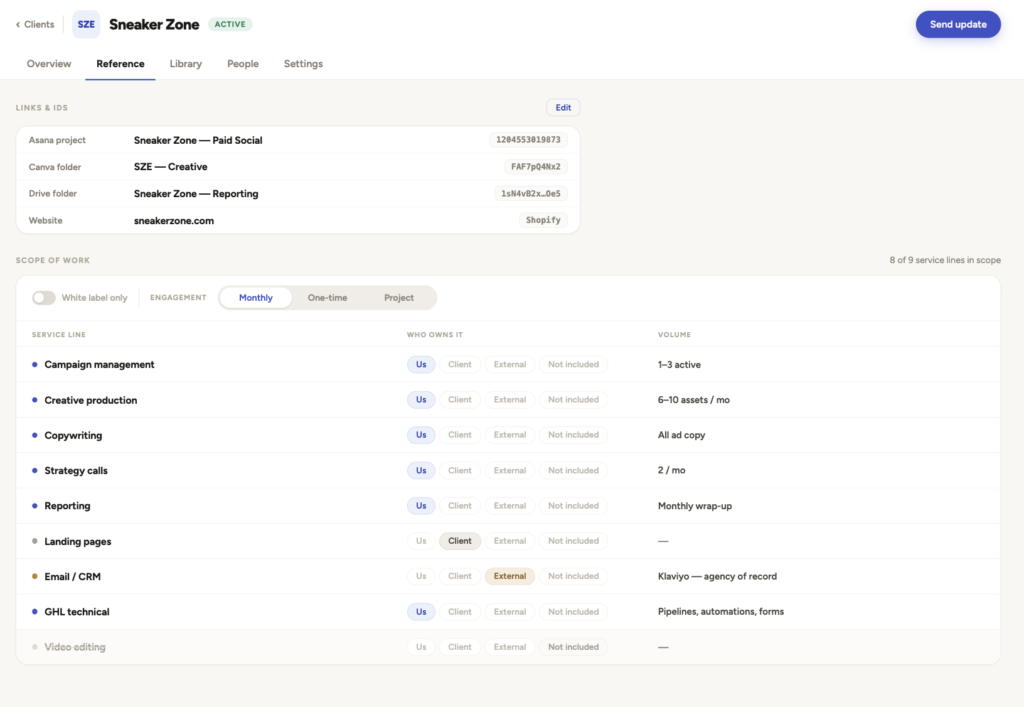
<p>Scopes:</p>

<figure class="wp-block-image size-large"><img src="/wp-content/uploads/2026/08/scope-example-1024x707.png" alt="" class="wp-image-706" /></figure>

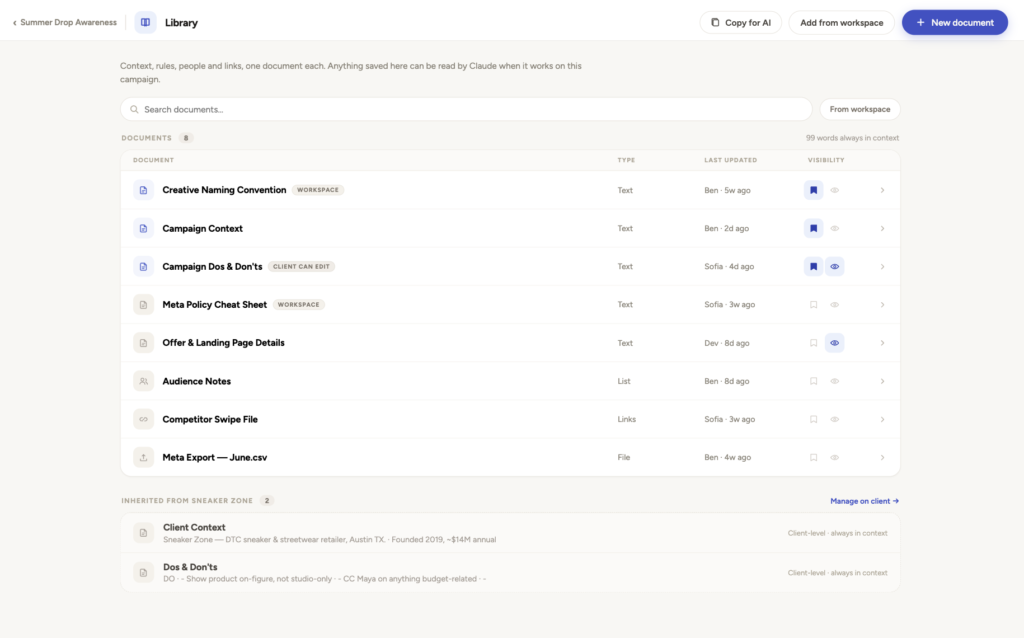
<p>And library documents, where I can store long form text and instruct Claude to read documents every time when tasked with dealing with a client:</p>

<figure class="wp-block-image size-large"><img src="/wp-content/uploads/2026/08/library-context-1024x638.png" alt="" class="wp-image-707" /></figure>

<p>This lets Claude understand who my clients are and what I owe them in terms of work scope, but also important things like <em>dos and don'ts</em>.</p>

<p>With that done, I created a simple Claude MCP custom connector so my Claude could connect and read from data inside the platform.</p>

<h2 class="wp-block-heading">2. List approved actions</h2>

<p>Now with the full client and campaign context, it can start to think.</p>

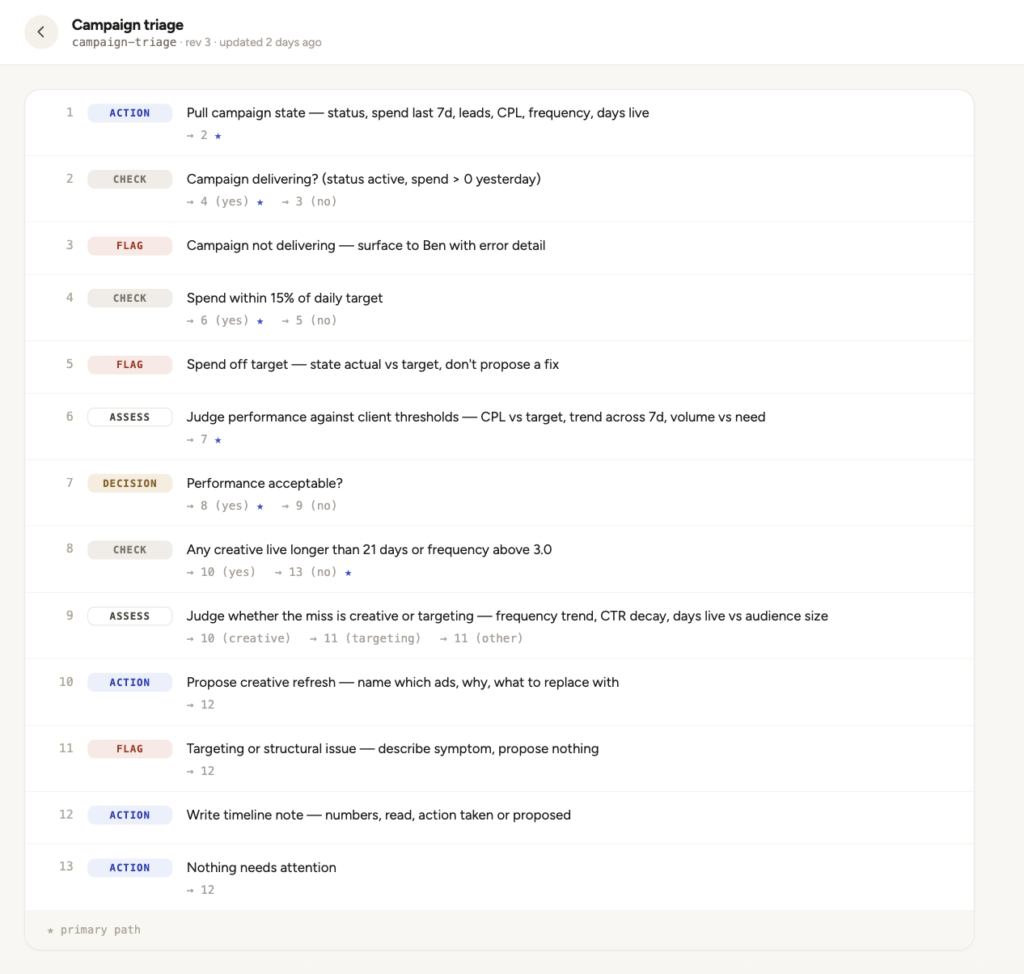
<p>In the beginning, I tried to hand over my thinking by writing out my entire mental process for diagnosing what to do next on every campaign, as a big logic tree the AI could walk through. </p>

<p>It was a feature for mapping and storing logic trees called Playbooks.</p>

<figure class="wp-block-image aligncenter size-large is-resized"><img src="/wp-content/uploads/2026/08/image-2-1024x974.png" alt="" class="wp-image-698" style="aspect-ratio:1.0513447432762837;width:446px;height:auto" /></figure>

<p>But I noticed after running this for awhile, Claude would get stuck on my process tree branch that explained onboarding, and couldn't find its way out because the context that onboarding had already happened was missing.</p>

<p><strong><em>Annoyingly, using a logic tree meant every little thing had to be recorded for the AI to properly come up with ideas.</em></strong></p>

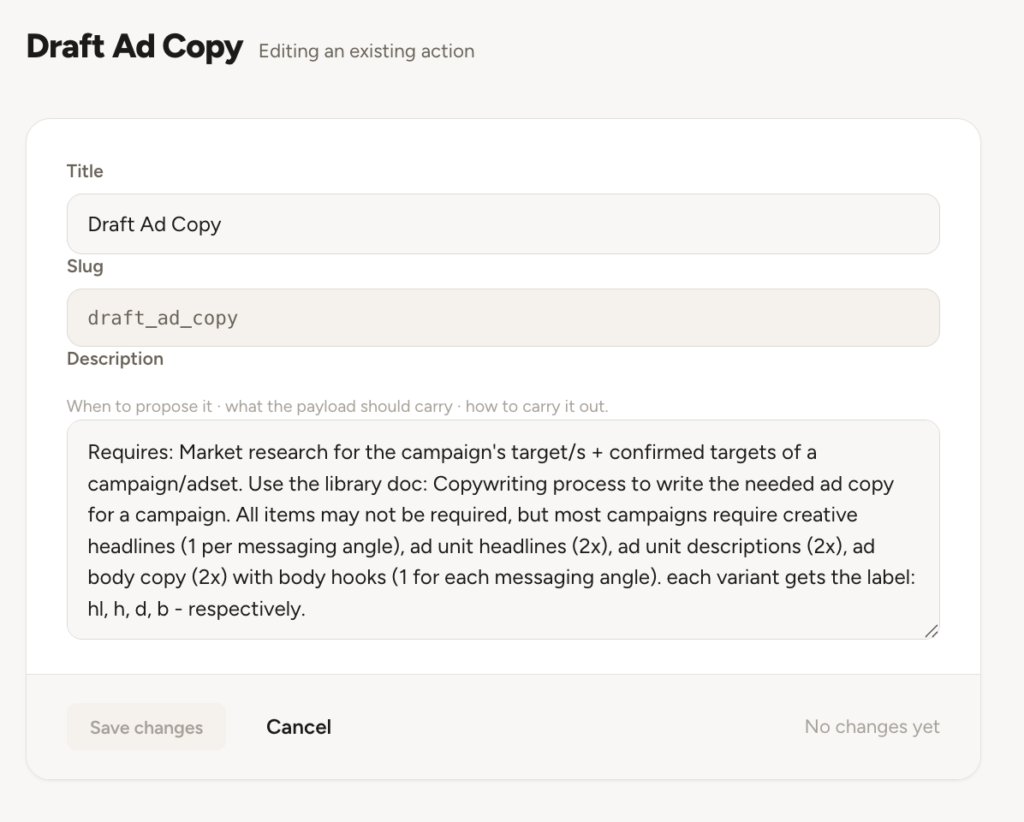
<p>So based on some advice from my friend David, I removed the playbook feature and gave it a menu of actions instead. Each one is basically title plus text on when and how to do it.</p>

<figure class="wp-block-image aligncenter size-large is-resized"><img src="/wp-content/uploads/2026/08/image-1-1024x822.png" alt="" class="wp-image-696" style="aspect-ratio:1.2458501841009235;width:400px;height:auto" /></figure>

<p>For example, "Create Asana card. Make an Asana card for a task a human has to do, because the AI currently doesn't have the ability to do it."</p>

<p>AI decides based on the context.</p>

<p>Somehow, giving it a menu of things that it could think about offering to do based on the current situation + a 360 degree view of a client's context and engagement scope made it easier for the AI to come up with the right ideas.</p>

<p>I couldn't simply list everything in the approved actions for it to do. They had to be executable by the AI via MCP and with context.</p>

<p>For example, there's no point putting "launch ad campaign" in there, because Claude can't do that (yet).</p>

<p>So I started with simple text-based things, like:</p>

<ul class="wp-block-list"><li>Writing ad copy</li>

<li>Adding Asana cards for my designer</li>

<li>Commenting on things, like emails or Asana</li>

<li>Recording long-term information in the context library</li>

<li>Sync recorded call texts to the library for reference</li>

<li>etc</li>
</ul>

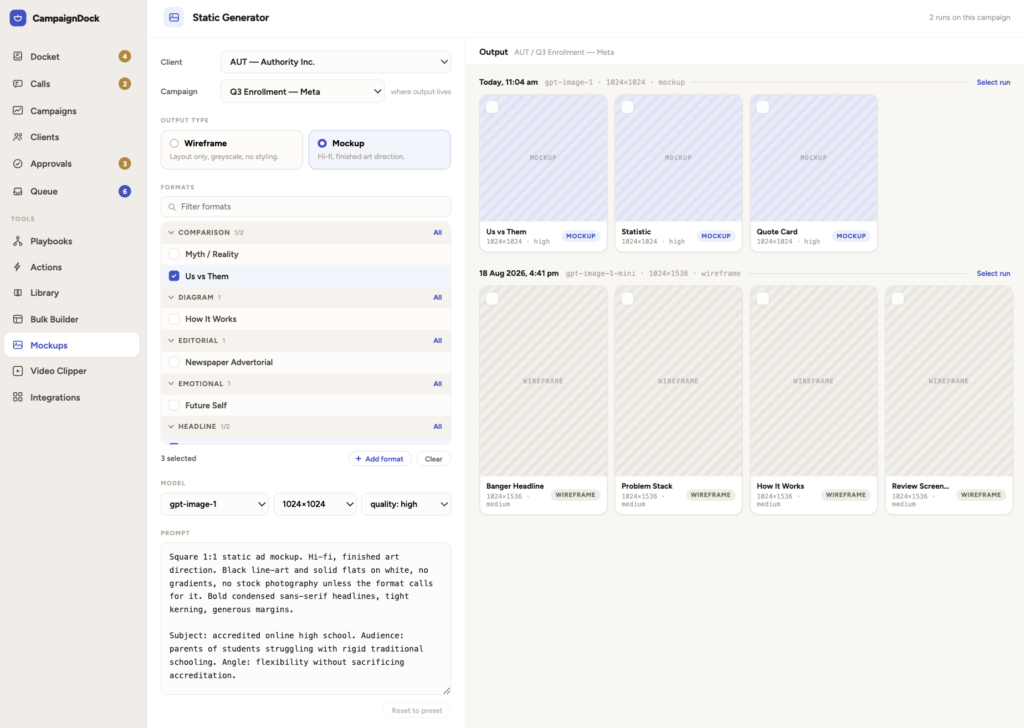
<p>Over time, I've ratcheted up its abilities by adding more tools and approved actions so now it can do non-text things like: </p>

<ul class="wp-block-list"><li>Generating ad visual concepts </li>
</ul>

<figure class="wp-block-image size-large"><img src="/wp-content/uploads/2026/08/mockup-generator-1024x728.png" alt="" class="wp-image-709" /></figure>

<ul class="wp-block-list"><li>Creating Meta campaign upload sheets that build campaigns instantly rather than clicking around.</li>

<li>Etc.</li>
</ul>

<p>All of these actions needed their own set of MCP tools so that Claude could properly execute these.</p>

<h2 class="wp-block-heading">3. Analyse and suggest on schedule</h2>

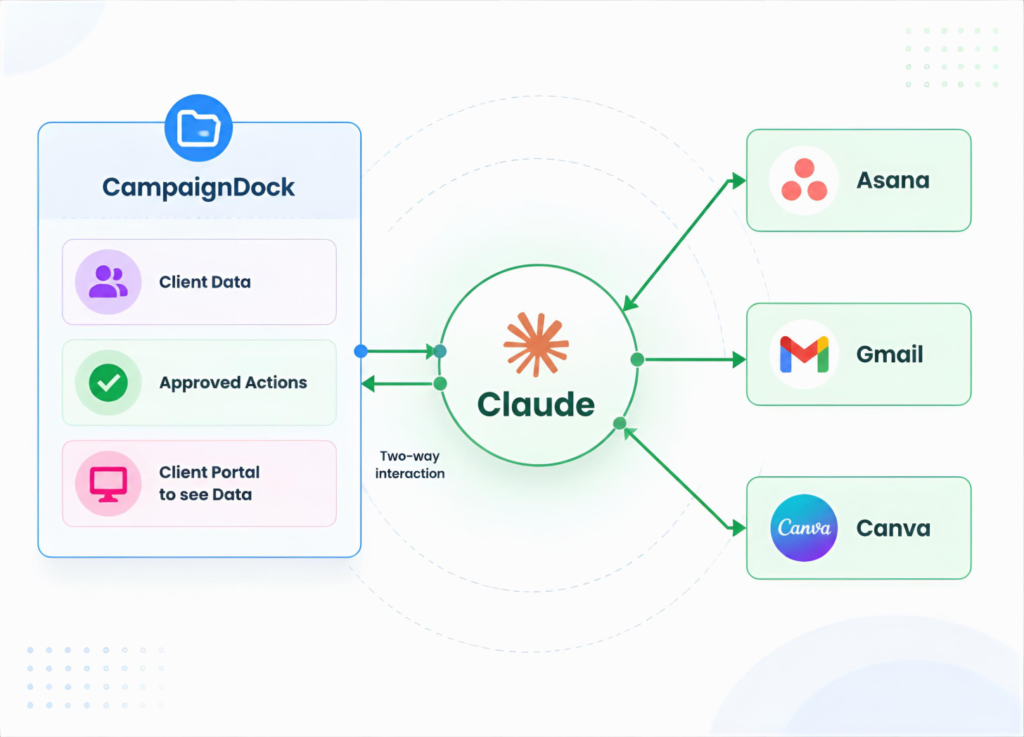
<p>Now with the context on the platform, and the list of approved actions, I could finally create the 2 step process I described earlier.</p>

<p>First, I have a scheduled Claude task that runs in the Cloud (so it survives the laptop being closed) that connects to the platform as well as:</p>

<ul class="wp-block-list"><li>Asana to see what tasks are live</li>

<li>Gmail to read client correspondence</li>

<li>Google Calendar for events</li>

<li>etc</li>
</ul>

<figure class="wp-block-image size-large"><img src="/wp-content/uploads/2026/08/system-overview-1024x737.png" alt="" class="wp-image-704" /></figure>

<p>*Sadly, I can't get all clients to communicate like it's the stone ages with email only - so it doesn't always get 100% of incoming communications. But it's close enough.</p>

<p>With those read, it then reviews the approved actions and suggests what to be done next for each. </p>

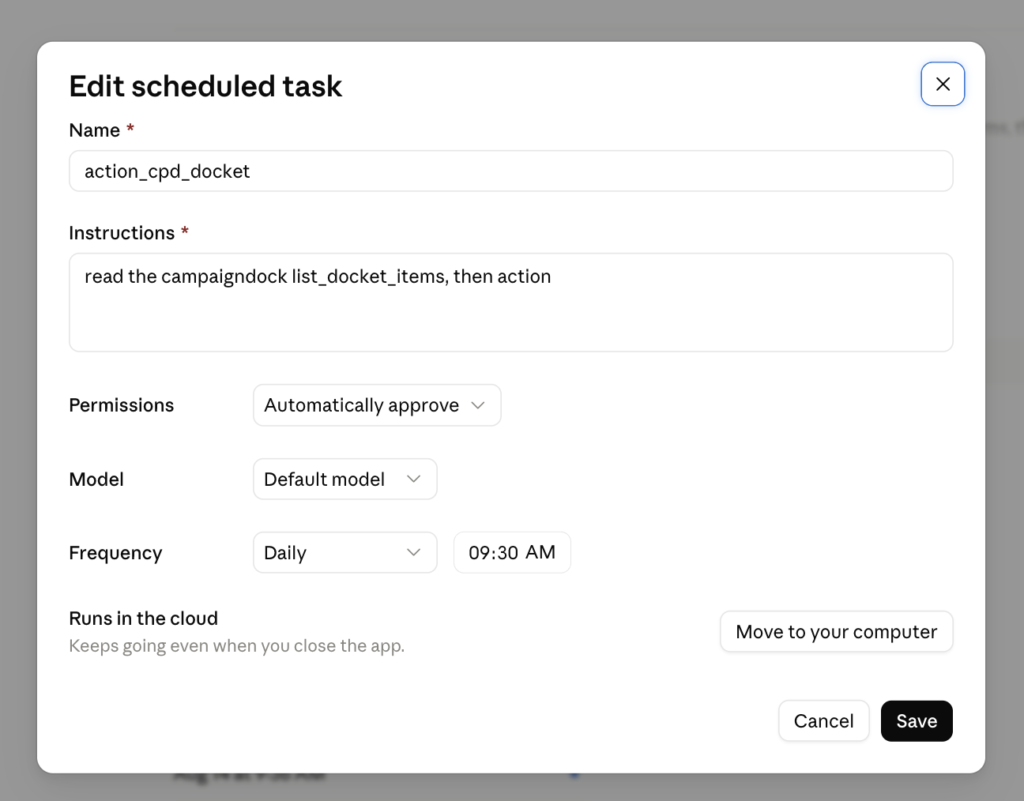
<p>Then the 2nd scheduled task runs 60 minutes after which simply says "do the approved tasks" with auto-approve on.</p>

<figure class="wp-block-image aligncenter size-large is-resized"><img src="/wp-content/uploads/2026/08/scheduled-tasks-1024x801.png" alt="" class="wp-image-712" style="aspect-ratio:1.2784143697739239;width:545px;height:auto" /></figure>

<p>By design, it can't do anything without my approval and without it being a pre-existing action on the menu. So I'm never surprised by the system going rogue and emailing a million people by accident or something.</p>

<p><strong><em>Side note: It may seem a bit different making the platform itself dumb, in that Claude operates outside of it</em></strong>.<strong><em> I did that so I wouldn't have to build some kind of connection with the app. Let the Claude team do that, or whichever LLM platform is the coolest a few months from now...</em></strong></p>

<hr class="wp-block-separator has-alpha-channel-opacity" />

<h2 class="wp-block-heading">Where to from here?</h2>

<p>Right now, it's day 13 ish and the platform has 200 suggested actions, 77 approved. It stores the reason for rejecting tasks, so it may be getting smarter, I hope. But it's early days, who knows. </p>

<p>Claude estimates I've saved ~17.2 hrs of work.</p>

<p>Why not the whole show? </p>

<p>Sadly, apart from not having everything actionable by the system yet - like work with videos, landing pages, and giving creative feedback... I realised that a lot of my work still can't be done easily by AI.</p>

<p>Stuff like:</p>

<ul class="wp-block-list"><li>Thinking through ad strategy across different verticals, timelines and resource constraints</li>

<li>Creating custom campaign plan documents with diagrams</li>

<li>Running client calls (lol)</li>

<li>Managing client requests to change things like copy, pages, campaigns, already created and in flight etc</li>

<li>Tastefully requesting edits, thinking through design improvements for clarity, etc</li>
</ul>

<p>The execution of approved things is almost never the heavy lift. Perhaps that's a good thing for my job security.</p>

<p>Regardless, I'm curious how far I can automate things from here. Who knows if the platform is still going and what it looks like a year from now.</p>]]></content><author><name>Benjamin Boman</name></author><category term="Uncategorized" /><summary type="html"><![CDATA[Back in March this year, my mate David shared with me this idea called the Hollow Engine problem by a guy called Michael Davidson on Twitter.]]></summary></entry><entry><title type="html">Alan Thomas from RevPact on Agency Sales [#30]</title><link href="https://benjaminboman.com/alan-thomas-agency-sales/" rel="alternate" type="text/html" title="Alan Thomas from RevPact on Agency Sales [#30]" /><published>2026-07-24T06:32:00+00:00</published><updated>2026-09-01T08:40:51+00:00</updated><id>https://benjaminboman.com/alan-thomas-agency-sales</id><content type="html" xml:base="https://benjaminboman.com/alan-thomas-agency-sales/"><![CDATA[<figure class="embed embed--spotify"><iframe src="https://open.spotify.com/embed/episode/0IH0yCX46otRBQeI2oAqUf" width="100%" height="152" frameborder="0" loading="lazy" allow="autoplay; clipboard-write; encrypted-media; fullscreen; picture-in-picture" title="Spotify"></iframe></figure>

<p>Most freelancers and agency owners assume a revenue dip is a lead problem. Alan Thomas runs Revpact, where he helps agency founders fix their sales process instead, and after a decade selling at Twitter and Time Doctor he's seen the same misdiagnosis 9 times out of 10. </p>

<p>In this episode we get into how to tell a conversion problem from a lead problem, the three-call process that stops proposals getting ghosted, and where AI SDRs actually earn their keep.</p>

<hr class="wp-block-separator has-alpha-channel-opacity" />

<h3 class="wp-block-heading">Timestamps</h3>

<ul class="wp-block-list"><li>[00:03] The number one thing agencies get wrong about sales</li>

<li>[00:07] The close rate that flags a conversion problem</li>

<li>[00:11] Building a pipeline you can actually diagnose</li>

<li>[00:16] Why one-call closing kills premium deals</li>

<li>[00:19] The three-call process that stops the ghosting</li>

<li>[00:27] Why you wait a few days between calls</li>

<li>[00:29] Why a presentation deck beats just talking</li>

<li>[00:39] Where AI SDRs actually work</li>

<li>[00:46] Why cold calling is the current opening</li>
</ul>

<hr class="wp-block-separator has-alpha-channel-opacity" />

<h3 class="wp-block-heading">Key links</h3>

<ul class="wp-block-list"><li><a href="https://revpact.io">Revpact</a> - Alan's agency sales consulting business</li>

<li><a href="https://revpact.io">Revpact newsletter</a> - weekly sales content for agency owners</li>

<li><a href="https://www.linkedin.com/in/alanpatrickthomas/">Alan on LinkedIn</a></li>

<li>Alan's <a href="https://www.youtube.com/@alanpatrickthomas">YouTube channel</a></li>
</ul>]]></content><author><name>Benjamin Boman</name></author><category term="Podcast" /><summary type="html"><![CDATA[]]></summary><media:thumbnail xmlns:media="http://search.yahoo.com/mrss/" url="https://benjaminboman.com/wp-content/uploads/2026/07/Alan-Thomas-300x300.png" /><media:content medium="image" url="https://benjaminboman.com/wp-content/uploads/2026/07/Alan-Thomas-300x300.png" xmlns:media="http://search.yahoo.com/mrss/" /></entry><entry><title type="html">My little course sold 35 copies. So I’m rebuilding it</title><link href="https://benjaminboman.com/ad-course-update/" rel="alternate" type="text/html" title="My little course sold 35 copies. So I’m rebuilding it" /><published>2026-07-13T09:41:48+00:00</published><updated>2026-07-13T09:41:48+00:00</updated><id>https://benjaminboman.com/ad-course-update</id><content type="html" xml:base="https://benjaminboman.com/ad-course-update/"><![CDATA[<p>Last year in March, I launched my first mini course on running your own Facebook lead ads. Friends kept asking me how to do it, even just the basics, so I thought why not record something people can refer back to, and make a little mini course out of it at the same time.</p>

<p>Honestly I felt like a bit of a douchebag though doing it, though. I'm not the world's most preeminent media buyer obviously, but I know my way around every lead gen campaign setup, so I shouldn't feel bad helping complete beginners do this.</p>

<figure class="wp-block-image aligncenter size-full"><img src="/wp-content/uploads/2026/06/here-in-my-garage.jpg" alt="" class="wp-image-497" /><figcaption class="wp-element-caption">Does anyone remember this guy?</figcaption></figure>

<p><strong>But in the end I sold 35 copies (!). </strong></p>

<p>16 through Udemy, which surprised me. It seemed to go off like a rocket by itself, though as I noticed later, a lot of those were people buying with coupons and not really consuming the course.</p>

<p>And the rest through Gumroad, plus 2 freebies to existing clients for a total of 37. These mostly came off my email list, which is about ~450 people. I sent two emails about it, maybe three. Thank you to those folks 🙏.</p>

<h2 class="wp-block-heading">Why I'm rebuilding it</h2>

<p>Something I noticed looking back on my little portfolio of projects is that I've had a nasty habit of letting things go. </p>

<p>And it's not because they don't get traction, it's just because of moving on too early.</p>

<p>For example, with Hypedeck.io, a previous idea, I sold 5 or 6 all one to one sales. But when it came to plugging in a scalable channel, I didn't give it a proper go.</p>

<p>I got an <a href="https://www.youtube.com/shorts/QIB27hjA8mA">awesome ad made</a>, but I didn't promote it, and by the time I got around to it the opportunity had passed. Everyone just generates landing page ideas with AI now.</p>

<p><strong>So I've realized it's one thing to filter my ideas, and then to get one to one sales. But it's another to setup a channel that keeps selling the thing in a scalable way.</strong> </p>

<p>I'm somewhat bookmarking this thought as a 3rd gate for my ideas.</p>

<p>Thinking aloud - that's probably why people doing well in the indiehacker space are often linked with particular channels like Danny Postma and SEO, for example, or organic social and old mate Levels.</p>

<p>(I haven't seen many indie hackers who are hot on ads though, it might be because low ticket products are genuinely crazy hard to promote).</p>

<p>Anyway, since this course shows traction - I shouldn't ignore it this time. So I want to press on and see if I can get it through gate 3. Using ads first, naturally.</p>

<h2 class="wp-block-heading">Updating the price</h2>

<p>Now, getting ads to work on a $27 offer with no upsell on the back end is pretty much impossible. And I'm not upselling anybody right now.</p>

<p>So I'm upping the price to $97, which gives me the leeway to make some profit on the front end. Or at least break even.</p>

<p>With a planned onboarding call included, I think it's a no brainer at that price, tbh.</p>

<p>Ads for low ticket is notoriously hard, so I'm a bit shy doing this on my own course in public, because if I can't get it working I look like a total dropkick lol. But to be fair, the course is about lead gen ads, not low ticket product sales through ads ... haha.</p>

<p>Given this, I need to build the value to fit this new price point.</p>

<h2 class="wp-block-heading">Building an offer</h2>

<p>Following the Hormozi (more like "Bromozi", am I right?) value formula, I've worked a little on the offer itself.</p>

<p>People might be lazy, so I'm including 5 static image templates with Canva, easy ones anyone could fill out. Plus I'll add my 80/20 ad copy template so it's easy as possible to get started. All stuff I use myself.</p>

<p>I'll also be including an onboarding help call with me that I mentioned before for personal 1:1 help. Maybe I find some clients this way, too.</p>

<h2 class="wp-block-heading">Improving the content</h2>

<p>Here's what I noticed people actually did with V1:</p>

<ul class="wp-block-list"><li>Nobody did the playbooks 😞</li>

<li>Nobody did the capstone</li>

<li>People liked the strategy ✅</li>

<li>Feedback was I didn't help much with the ad creative bit</li>
</ul>

<figure class="wp-block-image aligncenter size-large is-resized"><img src="/wp-content/uploads/2026/06/image-12-1024x645.png" alt="" class="wp-image-476" style="aspect-ratio:1.5876312449521173;width:516px;height:auto" /></figure>

<p>A big focus from this is to make it more completable. People have to actually use it in order to think I'm cool.</p>

<p>To do this, this time I'm focusing on 1 major "watch this and you're done, A-Z" video. I got that advice from my friend <a href="https://www.justinkhammond.com" type="link" id="www.justinkhammond.com">Justin Hammond</a>, who's been doing well with micro courses. His point has been to focus on a single transformation you can make quickly for the course taker.</p>

<figure class="wp-block-image aligncenter size-large is-resized"><img src="/wp-content/uploads/2026/06/image-11-1024x947.png" alt="" class="wp-image-475" style="aspect-ratio:1.081335952848723;width:420px;height:auto" /></figure>

<p>I've also planned out what could supplement it, so people get the transformation ASAP but can learn more if they want. E.g. setup for those who skipped it, things like finding offer ideas, creative research, landing page and Messenger variations, etc.</p>

<h2 class="wp-block-heading">Gumroad or Kajabi? Or something else</h2>

<p>For hosting this v2, naturally it'd make sense to keep it on Gumroad, but the experience felt a little too unpolished.</p>

<figure class="wp-block-image size-large"><img src="/wp-content/uploads/2026/07/image-2-1024x633.png" alt="" class="wp-image-662" /></figure>

<p>Meanwhile, Kajabi is kind of expensive at $143 (which is like a whole year of hosting?) for what is essentially a side thing.</p>

<p>So I thought, I'll keep developing my Ruby on Rails skills, and make a mini custom LMS as practice and self host it.</p>

<p>I started by creating the functional bare bones:</p>

<figure class="wp-block-image size-large"><img src="/wp-content/uploads/2026/06/image-13-1024x563.png" alt="" class="wp-image-493" /></figure>

<p>Doing this, I got to play with connecting a payments gateway using Gumroad, so people who buy there get redirected back and added as users. And I also set up email servers for the first time, using Resend. Neat experience for a total RoR newbie.</p>

<p>Then I did the design with Claude Design.</p>

<figure class="wp-block-image size-large"><img src="/wp-content/uploads/2026/07/image-1-1024x771.png" alt="" class="wp-image-660" /></figure>

<p>So far, honestly it's been about 5 or 6 hours tracked to get it here. And  I guess it's going to be a stretch of fixing of little details, so probably another 10 from here. </p>

<p>Ultimately, not the most efficient choice against $143 p/m of Kajabi. But I get the development reps and the control.</p>

<h2 class="wp-block-heading">Where to from here</h2>

<p>I'm still planning and recording the v2 content. But if you'd like to see what v2 looks like, the pre-sale version of the site is live here:</p>

<p><a href="https://leadads.guide">https://leadads.guide</a></p>

<p>To be sure, everyone who bought v1 gets v2, so I'll let them know once that's done too.</p>

<p>I also made a little promo video:</p>

<figure class="embed embed--video"><iframe src="https://www.youtube-nocookie.com/embed/KeVp-Og-W9Q" loading="lazy" allow="accelerometer; encrypted-media; gyroscope; picture-in-picture; fullscreen" allowfullscreen="" title="YouTube video"></iframe></figure>

<p>Once the v2 content is complete, I can start my ad campaign.</p>

<p>Let's see how it goes. Wish me luck.</p>]]></content><author><name>Benjamin Boman</name></author><category term="Uncategorized" /><summary type="html"><![CDATA[Last year in March, I launched my first mini course on running your own Facebook lead ads. Friends kept asking me how to do it, even just the basics, so I thought why not record something people can refer back to, and make a little mini course out of it at the same time.]]></summary></entry><entry><title type="html">The logic behind Thai time of day makes it easier to learn</title><link href="https://benjaminboman.com/thai-day-times/" rel="alternate" type="text/html" title="The logic behind Thai time of day makes it easier to learn" /><published>2026-07-12T05:11:08+00:00</published><updated>2026-07-12T05:11:08+00:00</updated><id>https://benjaminboman.com/thai-day-times</id><content type="html" xml:base="https://benjaminboman.com/thai-day-times/"><![CDATA[<p>I've often heard among other non-Thais that learning to tell the time in Thai is confusing. Especially the evening hour system of 1-5 thum (ทุ่ม).</p>

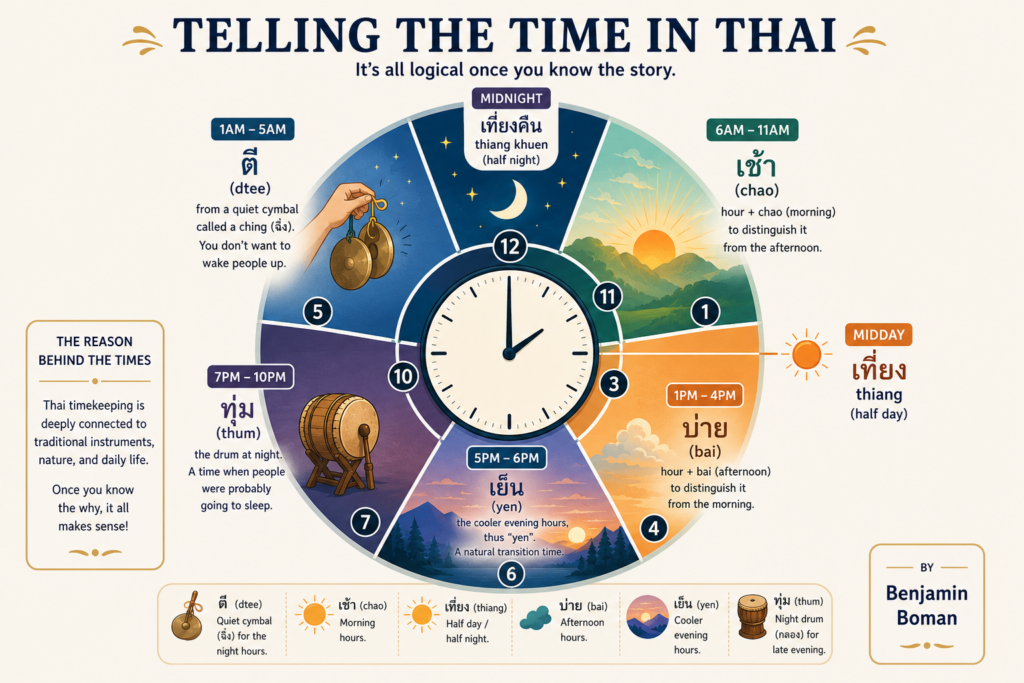
<p>So I thought there must be some logic to it. Why is the day split up so uniquely?</p>

<p>I did some quick research, and it turns out there is. And it helps with memorisation, too!</p>

<p>Firstly, I found out those confusing night hours are based on 1-5 strikes against a drum called a klong (กลอง). It's a barrel-type leather drum. So naturally, the sound "thum" also helps with memorising those hours.</p>

<figure class="wp-block-image size-large"><img src="/wp-content/uploads/2026/07/image-1024x944.png" alt="" class="wp-image-646" /></figure>

<p>Finding this out sent me down a rabbit hole wondering about the other times and their reasons. </p>

<p>It actually comes together nicely like this:</p>

<ul class="wp-block-list"><li><strong>Midnight</strong>: thiang khuen (เที่ยงคืน), literally "half night".</li>

<li><strong>1am to 5am</strong>: dtee  + number(ตี), from a quiet cymbal called a ching (ฉิ่ง). Makes sense, you don't want to blast something noisy and wake people up during those hours.<ul class="wp-block-list"><li>ตี also means <em>to hit</em>.</li>
</ul>
</li>

<li><strong>6am to 11am</strong>: number + hour + chao (เช้า means morning), just to distinguish it from the afternoon.</li>

<li><strong>Midday</strong>: thiang wun (เที่ยง), literally "half day".</li>

<li><strong>1pm to 4pm</strong>: number + bai + hour  (บ่าย, afternoon), just to distinguish it from the morning.</li>

<li><strong>5pm to 6pm</strong>: yen + hour + number (เย็น), the cooler evening hours, thus "yen". Makes sense mentally as a time you'd give a different name to.</li>

<li><strong>7pm to 10pm</strong>: number + thum (ทุ่ม), the drum at night. Imagine the drum being used, though I remember it as the time when people were probably going to sleep.</li>
</ul>

<p>Here's a quick infographic.</p>

<figure class="wp-block-image size-large"><img src="/wp-content/uploads/2026/07/thai-time-of-day2-1024x683.png" alt="" class="wp-image-655" /></figure>

<p>From that point of view, the times are much easier to remember.</p>]]></content><author><name>Benjamin Boman</name></author><category term="Uncategorized" /><summary type="html"><![CDATA[There's a logic behind the telling the time of day in Thai that makes it 10x easier to learn. Here's what I found out.]]></summary></entry><entry><title type="html">Key things I learned from Isabella Sanchez’s storytelling course</title><link href="https://benjaminboman.com/isabella-sanchez-storytelling-course/" rel="alternate" type="text/html" title="Key things I learned from Isabella Sanchez’s storytelling course" /><published>2026-06-17T09:40:47+00:00</published><updated>2026-06-19T09:44:22+00:00</updated><id>https://benjaminboman.com/isabella-sanchez-storytelling-course</id><content type="html" xml:base="https://benjaminboman.com/isabella-sanchez-storytelling-course/"><![CDATA[<p>I've been meaning to work on my short form video skills for a while now. Video usually performs better than statics, and everyone keeps saying story based formats do even better. </p>

<p>I got tired and envious of all these vloggers doing these little short story posts that look so effortless and natural, and I wanted to learn how to write video scripts the same way.</p>

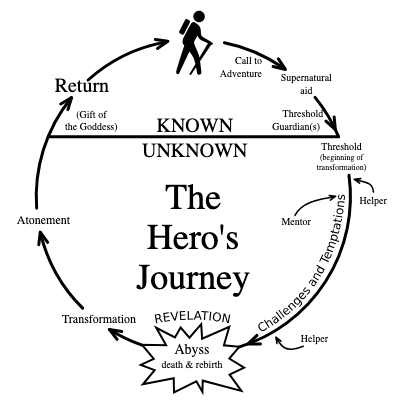
<p>The problem was most of the storytelling frameworks out there I came across are either too vague ("story telling is about pain!") or bloated. Like the hero's journey, it's like twelve different steps. </p>

<figure class="wp-block-image aligncenter size-full"><img src="/wp-content/uploads/2026/06/image-9.png" alt="" class="wp-image-411" /></figure>

<p>I don't know who's mashing that into a 15 or 30 second video.</p>

<p>So I started researching how social media storytelling works in a step-by-step way and came across <a href="https://www.theisabellasanchez.com/">Isabella Sanchez</a> who makes content specifically for vloggers on how to tell stories. Her course turned out to be perfect because I was looking for something that would teach it step by step.</p>

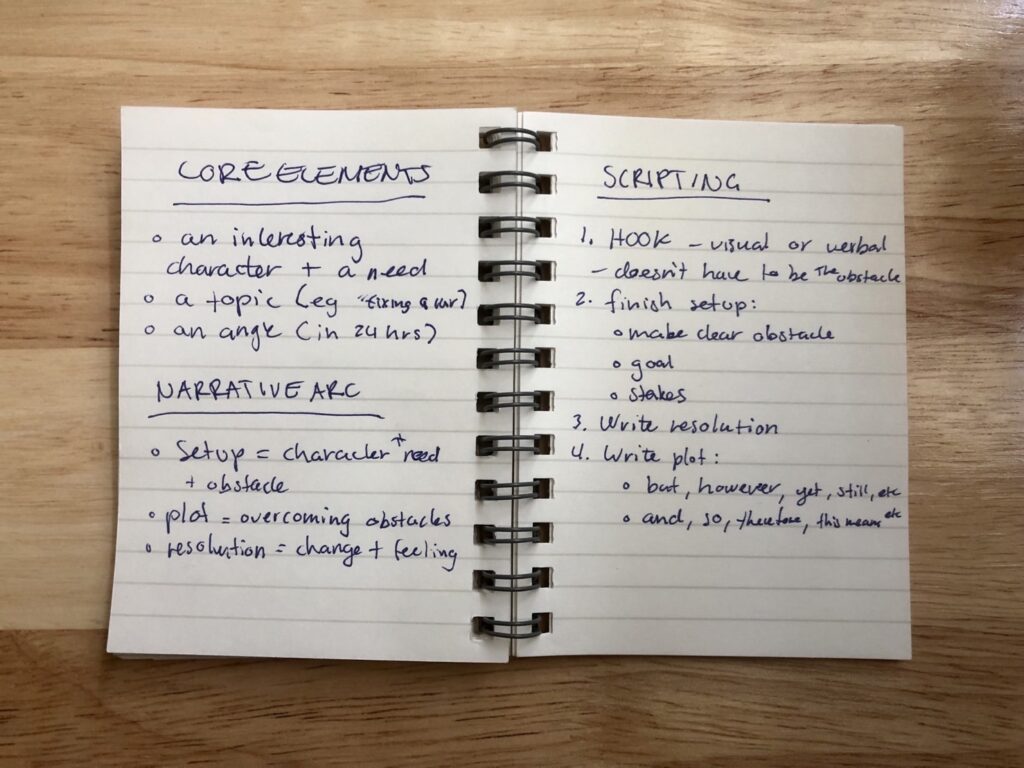
<p>In the course she teaches a framework for storytelling based on a few key beats (my paraphrasing):</p>

<ul class="wp-block-list"><li>Interesting characters</li>

<li>Have goals</li>

<li>With obstacles</li>

<li>Resolved</li>
</ul>

<p>Wrapped with a concept.</p>

<p>So an example could be something like <em>"Ranking the the best and worst pizza shops but only by their bathrooms because I'm a broke university student."</em></p>

<figure class="wp-block-image size-large"><img src="/wp-content/uploads/2026/06/bb-notes-storytelling-1024x768.jpg" alt="" class="wp-image-410" /></figure>

<p>Sounds stupid but the major thing that clicked for me was that the goal and obstacle are not the same thing. Even though it's easy to write like they are. </p>

<p>A lot of the times when I've written story-like video ads, I've conflated the two because it often seems like the goal IS the obstacle. Like "trying to get 1,000 YouTube subscribers." When the obstacle is more like being lazy, not knowing where to start, etc.</p>

<h2 class="wp-block-heading">Application</h2>

<p>I've used this on at least two shorts so far, including about <a href="https://www.youtube.com/shorts/Ctj69EvmOHA">how I'd go about learning ads again</a> (my very first attempt).</p>

<p>And on the blog, for these posts:</p>

<ul class="wp-block-list"><li><a href="/100-youtube-subscribers/">18 months to get 100 YouTube subscribers</a></li>

<li><a href="/writing-platforms/">Writing on platforms instead of my blog was a 3 year mistake</a></li>
</ul>

<p>The last one is interesting because it's technically macro-fail but people seemed to liked the way it was written.</p>

<p>No clean data on any of this yet but to be fair, I think that's less about the technique and more about reps. My bet is the more I do it, the better I'll get at dialing it in, for shorts, for the blog, and hopefully eventually for the ad scripts I'm writing for clients.</p>

<p>What I do now when I check a draft: </p>

<ul class="wp-block-list"><li>Make sure I have explicitly communicated a goal <em>and</em> an obstacle - making both clear.</li>

<li>Check if there is a narrative but/therefore line through to the clear conclusion, not simply a sequence of events.</li>
</ul>

<p>By the way it's absolutely worth the $97 I paid for this. It's one of the better short courses I've bought, and I've gone back through it two or three times now. You can get it on her website <a href="/suggests/isabella-sanchez-course/">here</a>.</p>]]></content><author><name>Benjamin Boman</name></author><category term="Uncategorized" /><summary type="html"><![CDATA[I've been meaning to work on my short form video skills for a while now. Video usually performs better than statics, and everyone keeps saying story based formats do even better.]]></summary></entry><entry><title type="html">Writing on platforms instead of my blog was a 3 year mistake</title><link href="https://benjaminboman.com/writing-platforms/" rel="alternate" type="text/html" title="Writing on platforms instead of my blog was a 3 year mistake" /><published>2026-06-15T11:28:11+00:00</published><updated>2026-07-01T04:39:13+00:00</updated><id>https://benjaminboman.com/writing-platforms</id><content type="html" xml:base="https://benjaminboman.com/writing-platforms/"><![CDATA[<p>In 2022 I read Nicolas Cole's book <em>The Art and Business of Online Writing</em> and loved one of his core ideas:</p>

<figure class="wp-block-image aligncenter size-medium is-resized"><img src="/wp-content/uploads/2026/06/image-8-300x300.png" alt="" class="wp-image-368" style="width:289px;height:auto" /></figure>

<p><strong>Write on platforms where people actually are, instead of your own website. If you publish on your blog, nobody's reading. These platforms also want to share your content, so you'll get a natural boost in readership if it's popular too.</strong></p>

<p>So over at least 3 years (!) I experimented with this. Yes I was a fool - I went all in. I moved and published all my content on social platforms: Quora, Reddit, Medium, Substack, Twitter and LinkedIn articles 🤦.</p>

<p>And as you may expect I now look back and regret it. </p>

<p>So with a lot of people swinging to Substack lately, I thought I'd write down some thoughts and data on this in case it gives some interesting context.</p>

<h2 class="wp-block-heading">The organic numbers</h2>

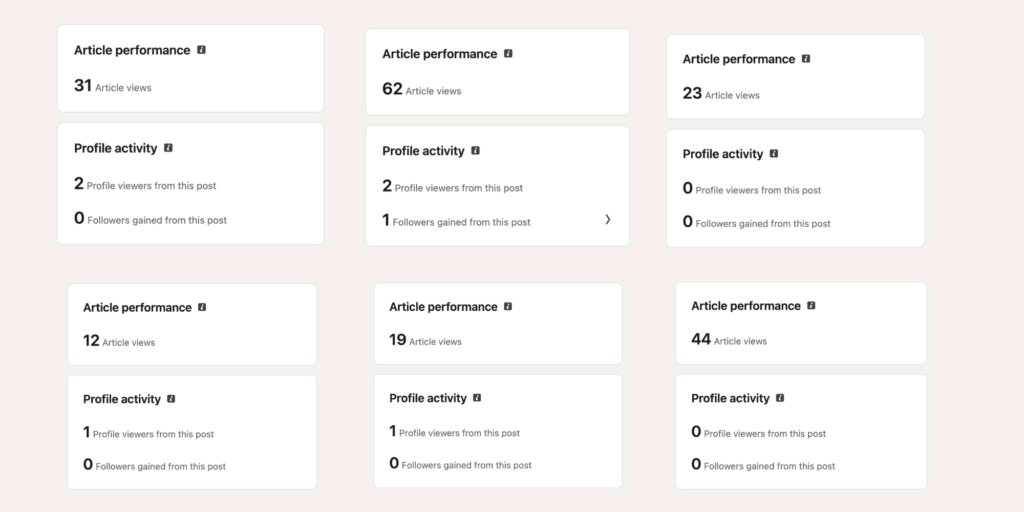
<p>On LinkedIn, a lot of my articles got about 40ish views.</p>

<figure class="wp-block-image size-large"><img src="/wp-content/uploads/2026/06/linkedin-article-performance-1024x512.png" alt="" class="wp-image-366" /></figure>

<p>To be fair, I write a lot about Meta ads there, so it's not that interesting. I assumed it would get in front of at least a few folks with an interest in the topic, but in the end not much.</p>

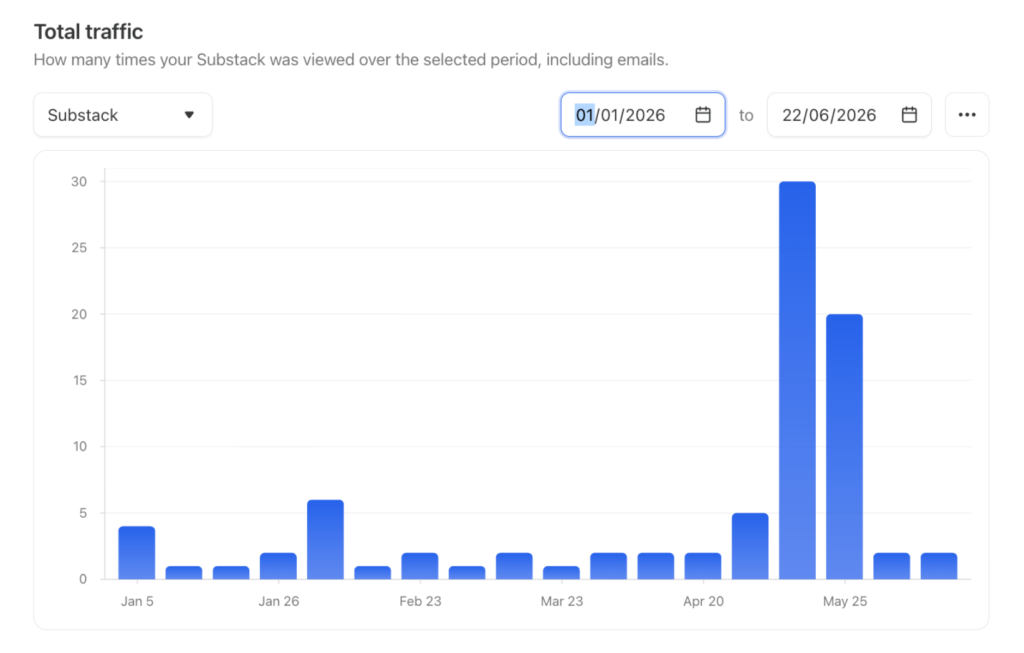
<p>For Medium, there wasn't any traffic from the platform itself. I directed folks there naturally from Reddit.</p>

<figure class="wp-block-image aligncenter size-large is-resized"><img src="/wp-content/uploads/2026/06/image-14-1024x653.png" alt="" class="wp-image-495" style="aspect-ratio:1.5681507369700654;width:537px;height:auto" /></figure>

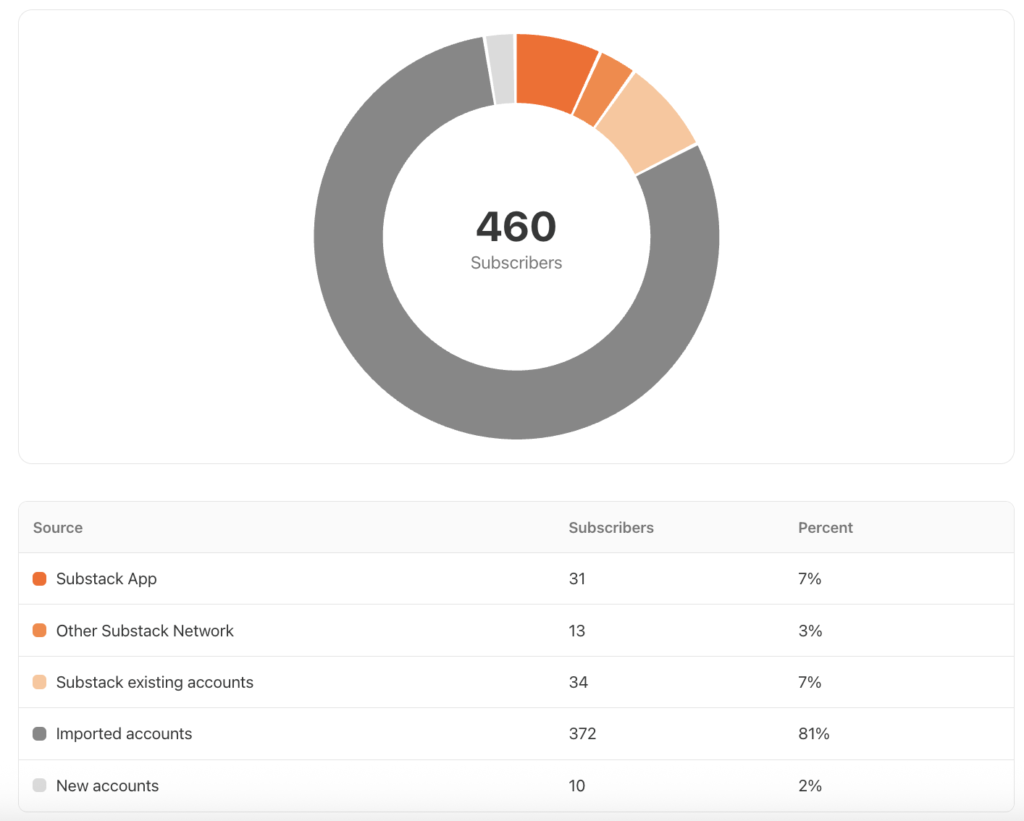
<p>Substack was decent, in that I got referrals from my friends' newsletters, building my list by about 100 folks, so I'm pretty thankful for that.</p>

<figure class="wp-block-image size-large"><img src="/wp-content/uploads/2026/06/image-17-1024x821.png" alt="" class="wp-image-612" /></figure>

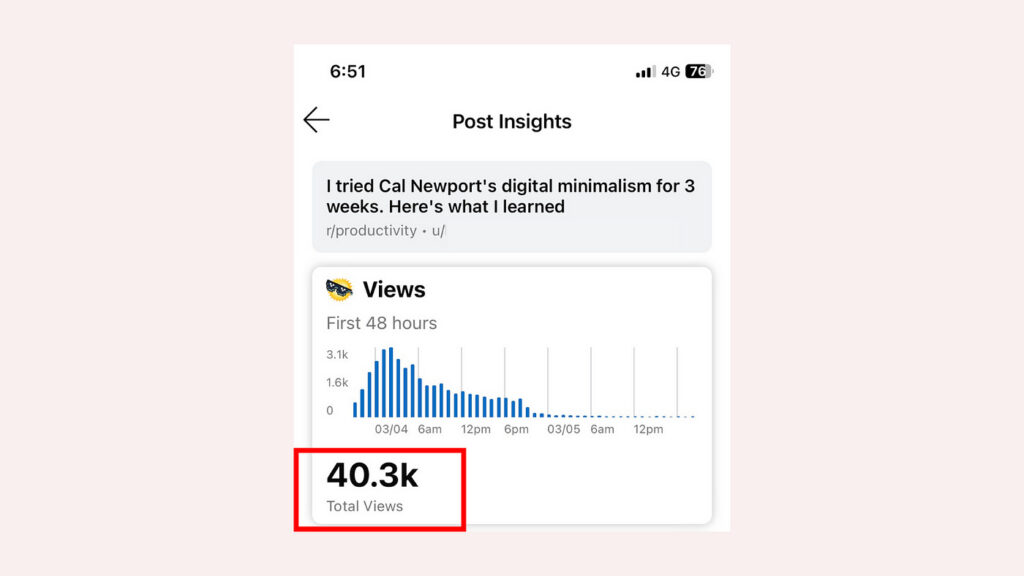
<p>On Reddit, I made a write up about <a href="/cal-newport-digital-minimalism-results/">my digital minimalism experiment</a>, which I posted to the digital minimalism subreddit for about 40,000 views.</p>

<figure class="wp-block-image size-large"><img src="/wp-content/uploads/2025/01/reddit-post-results-1024x576.jpg" alt="" class="wp-image-362" /></figure>

<p>But that lived on the platform. So I got the views and nothing really came of them.</p>

<h2 class="wp-block-heading">The drawbacks</h2>

<p>I think the Reddit post was the eye opener in retrospect.</p>

<p>If you're going to get someone's limited attention, you might as well foster that attention on your own page and not on a social one. </p>

<ul class="wp-block-list"><li>Firstly these platforms didn't really let me add much in the way of conversion modals, so it's harder to encourage people to become email subscribers. And secondly, my content was competing with everyone else's content pulling their attention away.</li>
</ul>

<ul class="wp-block-list"><li>Getting 40 views from a platform doesn't really move the needle, so I needed to promote the content anyway. But if I'm going to go to the effort of drawing people in, wouldn't it be a little less effective driving them to a social page?</li>
</ul>

<ul class="wp-block-list"><li>Then there's the links and comments. Each time I post or link or comment or try to ferry people to my work, they're tiny deposits that add up over time. But if these platforms shift and I need to move my work elsewhere, those links break. I can't 301 redirect them either. With my own site I can at least use the redirection plugin on WordPress.</li>
</ul>

<p><em>I shudder to think how many little links, mentions etc I lost from these past 3 years that could have stacked up.</em> All those great comments from friends and strangers that are lost, too.</p>

<ul class="wp-block-list"><li>Another drawback was the trends of the platforms themselves. Over time I noticed people started thinking of anyone who uses a platform, like Twitter or Substack, a certain way, and that changes. Rather than as human beings who just happen to use social media. Which I see as a bit of a risk if you're going to build your castle there.</li>
</ul>

<p>Which is related to the <em>worst</em> drawback. Getting sucked in.</p>

<ul class="wp-block-list"><li>Twitter pulls you into news and politics. LinkedIn has a lot of cringe content. Reddit has rabbit holes. Etc. To keep my profile engaged for a little smattering of traffic, I was active on these platforms, but they're designed to distract me with rot and outrage. Not a good ROI on time or mental bandwidth.</li>
</ul>

<p>So ultimately I think I would have been better off keeping everything here from the start. Just slowly building up those tiny deposits, and better leveraging whatever attention I managed to draw to my work here.</p>

<h2 class="wp-block-heading">What I'm doing now</h2>

<p>I'm not saying Nicolas Cole's idea was wrong. His point is obvious. Nobody is sitting around reading a blog unless you're famous, and the data supports the idea that platforms already have the readers.</p>

<p>But I think he has a more powerful point in the book, which is that we're not trying to build a blog. We're building a portfolio of content, informed by data (which tells you what to write more or less of), that can be redeployed on any platform depending on what's in favour with the algorithms at the time.</p>

<p>And I think I still get all of that with it on my own site. Yes, I'm still directing people back here to get anyone to read, but I'd have to do that anyway publishing on social platforms. Being on the platforms and writing on the platforms turned out to be two different things.</p>

<p>This has also made me realise that my email list using Kit (<a href="/suggests/kit/">link</a>) was doing most of the real work courting readership. So I'm changing how I use it, testing sending the whole post in the email rather than as part of a round up, with a click through link to read it online if people prefer.</p>

<p>For now I'm taking everything off LinkedIn and Substack and reposting it here. I'll still be on the platforms to share links back here, read and chat with people, but not trying to push them as home base for long-form content.<a href="/project/019e7c63-c73d-734c-bb39-c0117524f6c0"></a></p>]]></content><author><name>Benjamin Boman</name></author><category term="Uncategorized" /><summary type="html"><![CDATA[In 2022 I read Nicolas Cole's book The Art and Business of Online Writing and loved one of his core ideas:]]></summary></entry><entry><title type="html">18 months to get 100 YouTube subscribers</title><link href="https://benjaminboman.com/100-youtube-subscribers/" rel="alternate" type="text/html" title="18 months to get 100 YouTube subscribers" /><published>2026-06-01T06:00:00+00:00</published><updated>2026-06-19T09:37:55+00:00</updated><id>https://benjaminboman.com/100-youtube-subscribers</id><content type="html" xml:base="https://benjaminboman.com/100-youtube-subscribers/"><![CDATA[<p>I finally hit 100 subscribers on <a href="https://www.youtube.com/@hungrybeardigital">my YouTube channel</a> today. I thought I'd <s>self-congratulate</s> <em>ahem* </em>document this milestone and the things learned along the way. Hopefully one of many to come.</p>

<figure class="wp-block-image size-large"><img src="/wp-content/uploads/2026/05/image-8-1024x321.png" alt="" class="wp-image-98" /></figure>

<p><em>First - I know 100 is a laughable number. But maybe some of these reflections are useful for people sitting on the fence who've always wanted to give YouTube a go.</em></p>

<h3 class="wp-block-heading"><strong>Why YouTube?</strong></h3>

<p>I've often heard that YouTube is great for agency owners and freelancers. The quality of the leads that come from there is pretty good since they come in a bit warmer than other channels from seeing your face and voice.</p>

<p>So around 2025, I started pushing the channel. I called it <em>Ben @ Hungry Bear</em> inspired by <em>Brett @ Designjoy</em><sup data-fn="148dedc0-fa32-45a7-9f74-25114a163993" class="fn"><a href="#148dedc0-fa32-45a7-9f74-25114a163993" id="148dedc0-fa32-45a7-9f74-25114a163993-link">1</a></sup> but still kept the handle @hungrybeardigital in case I ever want to sell the agency somehow. I made it this way following my previous conclusion to <a href="/product-vs-audience-first">make products the focus of your personal brand</a>, not your following.</p>

<h2 class="wp-block-heading">At the beginning, learning YouTube has been more about the process of video creation than the algorithms itself. </h2>

<p>I found it really tough to begin honestly. </p>

<p>Not because YouTube itself is a difficult platform (it's actually amazing you can just post and get views for doing no promotion) but because of the process.</p>

<p>At first I was using Canva as a video editor, which as you might expect is just a pain in the neck. I'd have issues with the audio going out of sync, it wouldn't save properly, all that kind of crap. Editing one video was taking me 3 to 4 hours!</p>

<p>On top of that I spent another hour or two just agonising over thumbnails. AI-generated ones felt over-processed. Traditional ones felt wrong for me. The whole thumbnail thing was creating so much friction that I'd just... <em>not make the video</em>. I probably raged message dumped 2 youtuber friends on at least 2 separate occasions about this.</p>

<p>But over time, I've ended up going plain as day. And that was the unlock.</p>

<h3 class="wp-block-heading"><strong>Getting over being on camera</strong></h3>

<p>For the first 5 or 6 videos, I felt pretty self-conscious.</p>

<p>But I noticed after awhile, it just kind of stopped being a big deal.  barely think about it now for shorts or sitting at my laptop doing Loom style videos. <strong>The Loom style format helped a lot, too.</strong> Since your face is small and in the corner, it is mentally lot easier to process.</p>

<p>Funnily enough I noticed the same pattern back when I started podcasting. The first 3 to 5 episodes I was pretty nervous having people listen to my voice that closely. After those first few, it was totally fine.</p>

<h3 class="wp-block-heading"><strong>Cleaning up cringe videos</strong></h3>

<p>I also made some genuinely bad videos early on. I had a bunch about Twitter ads because I thought was going to be a new frontier. It wasn't. </p>

<p>In total I've delisted 14 embarrassingly bad videos over time and my views barely moved. </p>

<p>So if you're worried about looking back on your work later and cringing, this may be the solution.</p>

<h3 class="wp-block-heading"><strong>Fixing thumbnails</strong></h3>

<p>I came across a video by <a href="https://jimmymarshall.org/">Jimmy Marshall</a> that mentioned that a mismatch between thumbnail quality and video quality can hurt watch<sup data-fn="a9ee72fa-dfe2-4f45-bda2-58c64ff59e82" class="fn"><a href="#a9ee72fa-dfe2-4f45-bda2-58c64ff59e82" id="a9ee72fa-dfe2-4f45-bda2-58c64ff59e82-link">2</a></sup> time.</p>

<p>So based on that, I just gave up and I don't even bother trying to make one. </p>

<p>My thumbnails are basically the automated screenshots of the video itself, so at least they're consistent. CTR is okay:</p>

<figure class="wp-block-image size-large"><img src="/wp-content/uploads/2026/06/image-2-1024x629.png" alt="" class="wp-image-102" /></figure>

<h3 class="wp-block-heading"><strong>Editing with Descript instead of Canva</strong> </h3>

<p>Ultimately the biggest unlock was changing away from Canva editing, too. My mate <a href="https://www.greenlightstudio.co/">Jake</a> suggested I use Descript and that cut my editing time down to about 30 minutes now.</p>

<p class="has-accent-5-background-color has-background">Overall the process of writing the script is 30 to 60 minutes, recording is probably 30, editing 30 minutes to an hour. So all up maybe one and a half to two hours per video. </p>

<h2 class="wp-block-heading">Content strategy</h2>

<p>My original strategy was pretty basic. Just make Q&amp;A style videos based on stuff clients were asking me. I thought I'd send them to prospects, answer their questions, and build a bit of authority. Truthfully I almost never actually sent a single video to a client. </p>

<p>Then I was talking to Zohair Khan and he put me onto a YouTube teacher on YouTube strategy called <a href="https://www.youtube.com/@theaymanarab/">Ayman Arab</a>, who has a video where he explains his methodology for YouTube content - specifically for agencies.</p>

<figure class="embed embed--video"><iframe src="https://www.youtube-nocookie.com/embed/-eybpQUDMfc" loading="lazy" allow="accelerometer; encrypted-media; gyroscope; picture-in-picture; fullscreen" allowfullscreen="" title="YouTube video"></iframe></figure>

<p>He basically breaks it up into three types:</p>

<ol class="wp-block-list"><li>General Q&amp;A</li>

<li>Your unique perspective on things, trying to change people's minds on certain topics</li>

<li>Case studies and testimonials</li>
</ol>

<p>So I switched all my content to that format. What was cool was it made it really easy to know what to make. I was able to fill that middle layer, the unique perspectives with Loom style videos pretty easily.</p>

<p>I also started doing shorts. </p>

<p>My plan was a bit of a build-in-public angle alongside the Q&amp;A to scratch that public personal itch. I didn't follow through and kept doing Q&amp;A, though.</p>

<p><strong>For shorts, I don't think any of them got proper engagement in terms of comments, likes, etc and I've done about 9 so far. </strong></p>

<p>But they're quick to edit. So I've found I can batch 2 or 3 in one sitting. My gut says there's probably an opportunity here I'm not properly using yet.</p>

<figure class="wp-block-image size-large"><img src="/wp-content/uploads/2026/06/image-3-1024x491.png" alt="" class="wp-image-103" /></figure>

<p>As an side, one of my simpler how-to videos, literally 60 seconds on how to download leads from Facebook, <strong>got 22,000 views</strong> because people were searching for it. Hasn't lead to a single inbound inquiry. </p>

<h2 class="wp-block-heading">Business results</h2>

<p>Overall, my 32 videos over 18 months have resulted in:</p>

<ul class="wp-block-list"><li>10~ content signups (First on Gumroad, then on GHL)</li>

<li>2-3 inbound email enquiries</li>

<li>1 podcast invitation (<a href="https://podcasts.apple.com/us/podcast/66-the-overlooked-warning-sign-youre-wasting-money-on/id1756934379?i=1000726470745">published here</a>) </li>

<li>2 booked calls, 1 showed up</li>

<li>1 client</li>

<li>New friends</li>
</ul>

<p>A big stuff up I made was not properly fleshing out the funnel for my content offers. First it was on Gumroad while I tried running things completely on social platforms, which isn't great for nurturing into booked calls, and then later on GoHighlevel but I haven't yet fully setup the thank you page to convert properly.</p>

<p>What is cool though is that 2 leads booked. 1 showed up. They'd watched my content before getting on the call and liked that I didn't dress things up or have a lot of pizzazz, that my content was to the point and the ideas made sense. They were pretty ready to go by the time we spoke.</p>

<p>One data point to support the YouTube leads come in much warmer, not enough of sample to draw conclusions from, but it's something.</p>

<h2 class="wp-block-heading">What's next?</h2>

<p>From here, growing the channel seems to come down to general character bandwidth at this point: how disciplined I am with my time. It's pretty clear what to do and how.</p>

<p>Some action points to update on:</p>

<ul class="wp-block-list"><li>Finish building the funnels properly. The thank you page should offer to help people implement the lead magnet advice instead of just remind them the content came by email.</li>

<li>Actually invest in getting testimonial videos done. That's the third pillar of the Ayman Arab framework and I haven't properly executed it.</li>

<li>Get more consistent. Maybe bed down a 1x a week recording rhythm.</li>

<li>Work out what to do with shorts. Keep doing them? Change purpose/strategy?</li>
</ul>

<hr class="wp-block-separator has-alpha-channel-opacity" />

<p>I hope the summary was interesting.</p>

<p>If you're sitting on the fence about starting a YouTube channel because you're uncomfortable on camera, my #1 recommendation is to just focus on pushing through the first 5 videos. </p>

<p>Then it pretty much doesn't bother you anymore.</p>]]></content><author><name>Benjamin Boman</name></author><category term="Uncategorized" /><summary type="html"><![CDATA[I finally hit 100 subscribers on my YouTube channel today. I thought I'd self-congratulate ahem* document this milestone and the things learned along the way. Hopefully one of many to come.]]></summary></entry></feed>